
Hyperliquid is achieving something many DeFi projects have been promising for years: generating substantial revenue from a product that users consistently rely on.
Its perpetual futures platform has become one of the leading names in decentralized trading. Its native token, HYPE, has also held up better than much of the market in recent weeks.
Its growth raises questions that go beyond HYPE’s price. For years, numerous crypto projects sought to attract capital through new blockchains, promises of scalability, and financial incentives. Hyperliquid offers a different argument: an application capable of generating revenue may be more valuable than infrastructure whose main advantage has yet to be demonstrated.
Hyperliquid Turns Trading Activity Into Revenue
According to DefiLlama, Hyperliquid generated approximately $69 million in revenue during October, from around $88 million in fees. Over the past 30 days, the protocol has recorded roughly $67 million in revenue, placing it among the sector’s most profitable businesses.
Its trading volume is equally impressive. Its perpetual futures market processed more than $220 billion in trading volume over 30 days, according to DefiLlama data.
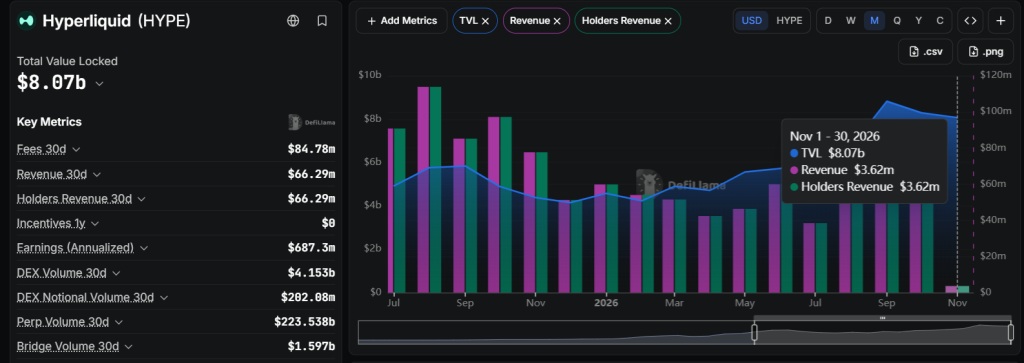
These figures matter because they come primarily from fees paid by traders who actively use the product. They are not equivalent to liquidity deposited in a protocol or a valuation based solely on expectations.
This distinction calls for a reassessment of how success is measured in decentralized applications. A blockchain can have a high market capitalization and numerous applications without generating substantial revenue. Hyperliquid has built a business around a specific activity and attracted traders willing to pay to use it.
The Risks of HYPE’s Model
The relationship between revenue and the token is one of Hyperliquid’s main attractions. The protocol directs approximately 99% of certain fees to the Assistance Fund, which uses those resources to purchase HYPE on the market.
This mechanism creates a connection between trading activity and demand for the token. The more fees the protocol collects, the more resources may become available for those purchases.
However, buybacks do not guarantee that HYPE’s price will rise. Its valuation also depends on available supply, investor selling, expectations, and broader market conditions.
Revenue should not be confused with traditional corporate profits, either. The amounts reported by data aggregators correspond to protocol activity and its distribution mechanisms. They do not automatically represent a company’s net profit after all expenses.
There is another important vulnerability: Hyperliquid relies heavily on derivatives trading. When trading volumes decline or traders reduce their exposure, fee revenue can fall.
In fact, its revenue has fluctuated considerably. It fell from approximately $114 million in August 2025 to around $38 million in July 2026, before recovering in the following months.
Nevertheless, its growth does not eliminate the risks associated with liquidations, leverage, liquidity concentration, and competition between platforms.

DeFi’s Future Depends on More Than Building New Networks
Hyperliquid is also expanding its markets through HIP-3, which allows third parties to create perpetual contracts on different assets. This feature could attract new users, although it also changes how fees are distributed.
The growth of these markets has reduced the share of revenue the protocol retains from certain transactions. Higher trading volume does not always translate into higher revenue for Hyperliquid.
That distinction is crucial when evaluating the sustainability of its model. Commercial success should be measured by the revenue the protocol actually retains, not simply by the number of contracts traded.
It would also be an exaggeration to claim that Hyperliquid will eliminate traditional decentralized finance. Lending protocols, decentralized exchanges, and other financial services serve different needs. Many can operate alongside the DEX and even integrate with its infrastructure.
Competition may ultimately favor protocols that combine recurring revenue, reasonable costs, and genuine utility for their users. Hyperliquid already has results to support its model, although it still needs to demonstrate that it can sustain them through prolonged periods of lower activity.
Its greatest contribution to DeFi is not eliminating its competitors, but raising the standards they must all meet.