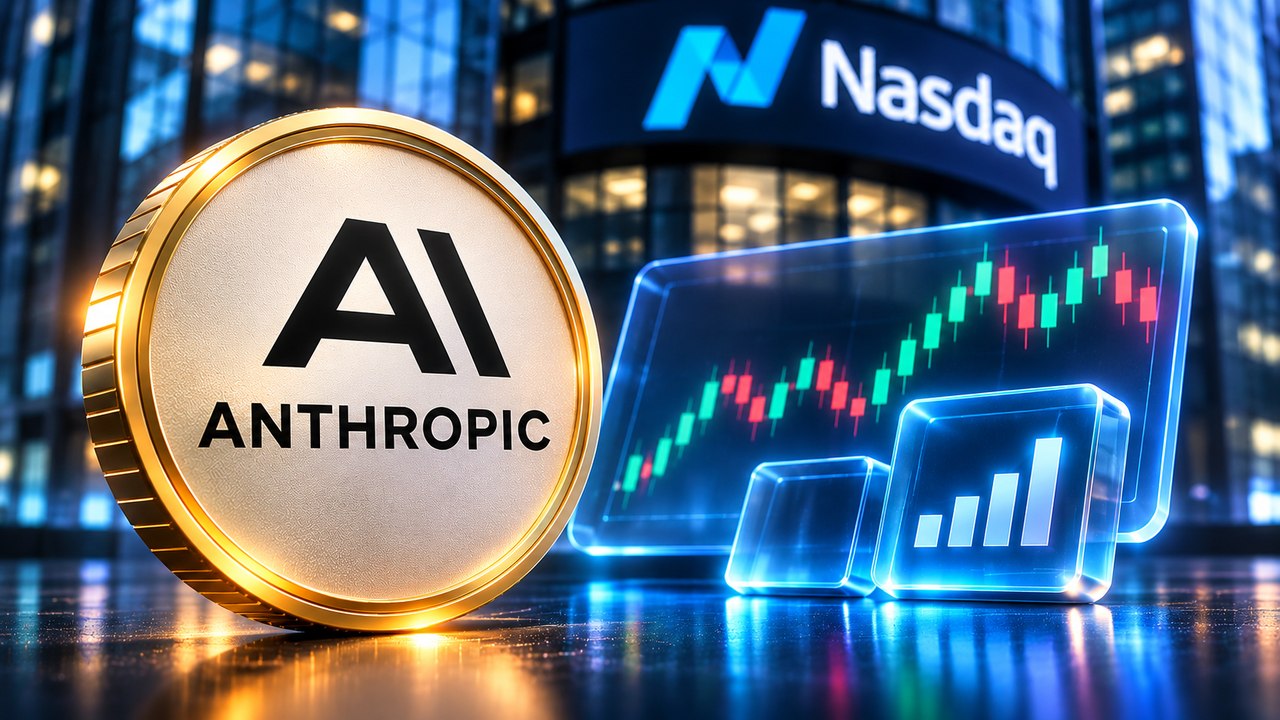
Anthropic’s stock market debut triggered a race among blockchain platforms to offer tokenized versions of its shares. Millions of dollars were traded within hours, but the initial activity does not mean these products have enough liquidity to compete with traditional markets.
Backpack, Ondo Finance, xStocks, and Securitize launched instruments linked to Anthropic as the company began trading on Nasdaq. Demand was considerable even as U.S. technology stocks declined and cryptocurrencies remained under pressure.
This raises a question: Is tokenization attracting new capital, or is it simply offering another way to speculate on the most popular stocks?
Tokenization has genuine utility, but it still needs to prove it can deliver sufficient market depth, competitive pricing, and adequate legal protections. The excitement surrounding an IPO does not resolve those requirements.
Anthropic Attracts Capital, but Liquidity Is Unevenly Distributed
According to data compiled by Solana Compass, Anthropic’s tokenized products generated more than $29 million in trading volume during approximately their first 90 minutes of activity on Solana.
The version issued by Backpack Securities recorded nearly $26.8 million, accounting for around 92% of the volume associated with three issuers.
Although several platforms announced products linked to Anthropic, most of the trading took place through a single instrument.
Trading volume is also not the same as available liquidity. A token can generate millions of dollars in transactions while still having insufficient orders to execute large purchases or sales without affecting its price.
Assessing market depth requires examining bid-ask spreads, the capital available at different price levels, and the cost of executing large trades.
Furthermore, these products do not operate in identical ways. Ondo offers direct issuance and redemption of ANTon, meaning some of its activity does not appear in decentralized exchange trading volumes.
Comparing only transactions recorded on blockchain can conceal important differences between trading mechanisms.
Around-the-Clock Trading Does Not Guarantee Better Prices
The main commercial advantage of these instruments is that they allow trading outside regular U.S. stock market hours.
Ondo Finance announced that ANTon would support issuance and redemption 24 hours a day, including weekends, for eligible investors outside the United States.
This appeals to investors in other time zones or those who need to adjust their positions when Nasdaq is closed.
However, a market that remains open around the clock needs buyers and sellers willing to trade under those conditions.
When the underlying stock is no longer trading, it becomes harder to determine whether the token’s price matches the value the stock would reach when the market reopens.
Intermediaries may widen bid-ask spreads to protect themselves against that uncertainty. As a result, trading overnight or during weekends could become more expensive.
Binance’s documentation also warns that tokenized instruments such as those linked to Anthropic may experience heightened volatility outside regular trading hours and may not always track the underlying stock’s price in real time.
Around-the-clock availability is an operational improvement, but it loses value if users must accept considerably worse prices.
Share Ownership Remains a Problem
Another distinction often gets lost amid the announcements: buying a token linked to Anthropic does not necessarily make the investor a shareholder in the company.
Binance warns that ANTx provides price exposure but does not grant direct ownership, voting rights, or other shareholder rights.
It also notes that the backing assets may include cash or other eligible instruments, rather than exclusively holding the corresponding shares.
This raises concerns involving the issuer, custodian, and redemption conditions.
Not all products offer the same protections. That is precisely why the term “tokenized” is insufficient to explain what investors are actually buying when trading Anthropic’s tokenized shares.
Institutional-grade infrastructure requires clear rules governing ownership, reserves, settlement, and claims in the event of a default.
Blockchain can record transfers quickly, but it does not automatically eliminate legal obligations or the intermediaries backing the instrument.
The Challenge After the Debut
Anthropic’s initial success confirms that there is clear interest in trading stocks through blockchain. It also shows that platforms can prepare products quickly to capitalize on major stock market events.
But $29 million in trading volume during an exceptional debut is not enough to declare that tokenization has transformed the stock market.
Trading activity will need to continue after the initial attention fades, with narrow spreads, sufficient liquidity, and reliable redemption mechanisms.
Investors must also be able to clearly identify their rights and the risks associated with each issuer.
Tokenization needs to develop further because it can extend trading hours and make markets accessible to new investors internationally. Its main challenge is no longer proving that a share can be represented by a token, but offering conditions comparable to those of an established financial market.
For now, products linked to Anthropic remain an interesting alternative for certain investors, but they are still insufficient to replace traditional stock market infrastructure.