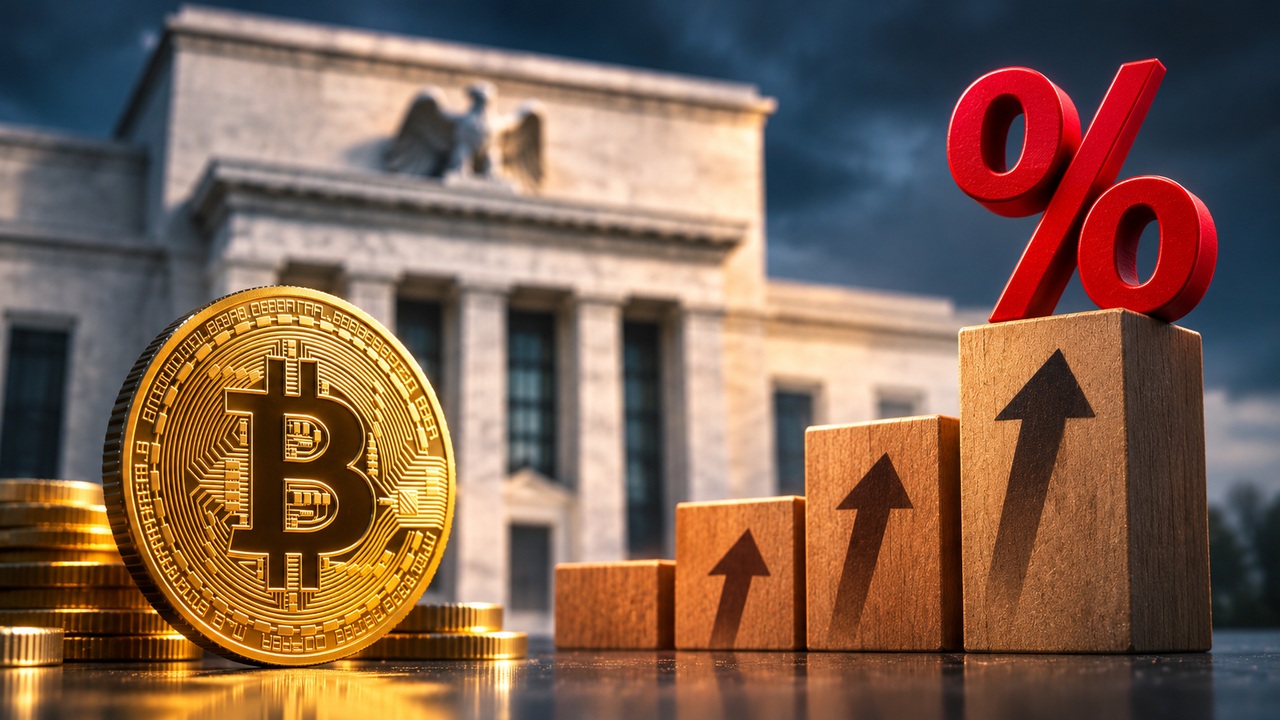
The crypto market faces a threat that no technical recovery can resolve on its own: the possibility that the Federal Reserve will keep interest rates elevated longer than expected.
Bitcoin is trading around $64,000, and investor sentiment is dominated by extreme fear. Another rate hike could put additional pressure on cryptocurrencies.
Futures markets are already largely pricing in another increase in December. However, even an expected decision can trigger losses if investors begin anticipating even tighter monetary conditions.
The idea that one final Fed-driven decline could establish a lasting bottom is appealing. But there is no guarantee that another sell-off will bring the market’s weakness to an end.
The problem could persist as long as traditional financial instruments offer high yields and cryptocurrencies must compete for capital.
October’s Fed Minutes Could Complicate Expectations
The Fed will release the minutes of its October 27–28 meeting, when it decided to maintain the federal funds target range at 3.75% to 4%.
According to the Federal Reserve’s official calendar, the document will be published ahead of the next meeting, scheduled for December 8–9.
Investors will look for information about officials’ inflation concerns and their willingness to continue tightening monetary policy.
But the minutes describe earlier discussions. They do not constitute an advance decision on December, particularly if economic data released afterward have changed the outlook.
This distinction matters because the market may react less to the next rate hike than to signals about how long interest rates will remain elevated.
If officials believe restrictive monetary policy must remain in place for several more months, expectations of a rapid recovery in risk assets would weaken.
The Cost of Holding Cryptocurrencies Is Rising
Higher interest rates influence investment decisions because they allow investors to earn greater returns on fixed-income instruments.
An investor who can buy U.S. government debt with a known yield needs stronger incentives to hold assets exposed to sharp price fluctuations.
Bitcoin and other cryptocurrencies can appreciate considerably, but simply holding them does not provide a guaranteed return.
Furthermore, borrowing becomes more expensive when interest rates rise. This can limit leveraged positions and reduce the capital available for speculative trading.
The impact is not uniform. Smaller projects, with less liquid markets and greater dependence on new investment, may face greater difficulties than Bitcoin.
That is why a 25-basis-point increase should not be assessed solely by its size. What also matters is whether it changes expectations for future decisions and financing conditions.
The Fed does not need to trigger a massive sell-off to hurt the crypto sector. Keeping a profitable, less volatile alternative available for longer may be enough.

One Final Sell-Off Does Not Guarantee a Market Bottom
Extreme fear often fuels expectations that sellers are close to exhaustion.
However, the crypto market can remain weak even after a substantial decline. Negative sentiment alone does not indicate how much capital is prepared to return.
If the Fed raises rates again in December, another liquidation could occur among traders who still hold leveraged positions.
That decline could eliminate some of the speculative excess, but it would not automatically resolve the lack of buyers.
For a sustainable bottom to form, selling pressure must be met with sufficient demand. Crypto investors must also be able to maintain their positions without depending on an immediate rate cut.
Mistaking an intense sell-off for the end of a downtrend can lead investors to buy too early.
Previous monetary policy cycles also provide no basis for assuming an automatic relationship between the final rate hike and Bitcoin’s lowest price.
The Real Challenge Is Enduring High Interest Rates
The possibility of a recovery does not disappear simply because the Federal Reserve maintains restrictive monetary policy.
Cryptocurrencies can attract capital for reasons of their own, independently of central bank decisions. But that demand must be strong enough to offset the greater appeal of traditional financial instruments.
Expecting an immediate change in monetary policy turns every rebound into a bet on the next Fed meeting.
The crypto market needs buyers capable of maintaining their investments even if the Fed does not cut rates for several months.
Another increase could accelerate selling, but it could also prolong a period of weak prices without triggering a definitive capitulation.
The main risk is not necessarily a sharp decline after December. It is that crypto investors continue waiting for monetary relief that the Fed is not yet prepared to provide.