
The regulated stablecoin market is delivering something much of the crypto industry has promised for years: turning blockchain technology into a practical tool for everyday use. Its main appeal no longer rests on speculative profits, but on the ability to transfer money, pay suppliers, and settle transactions without relying on traditional banking processes.
The answer to whether stablecoins are transforming crypto payments is yes, although they have not yet replaced existing payment systems. Commercial adoption is growing, and major financial institutions are already incorporating these assets into their services. However, the regulations that could accelerate their expansion also threaten to leave the market in the hands of a few issuers.
Stablecoins Are Starting to Find Users Beyond Trading
The US Office of the Comptroller of the Currency (OCC) approved the final rules implementing the GENIUS Act, which will take effect on January 18, 2027. The regulations establish requirements covering reserves, redemptions, risk management, and oversight of payment stablecoin issuers.
For a company sending money overseas, the certainty of being able to redeem its holdings for dollars is far more important than any promise of returns. Regulatory requirements can help build that confidence, although compliance will impose costs that smaller issuers may struggle to afford.
Commercial activity is also beginning to justify the interest. According to data from Allium, stablecoin payments reached $482 billion between January and September 2026, an increase of 45%, despite stagnant circulating supply.
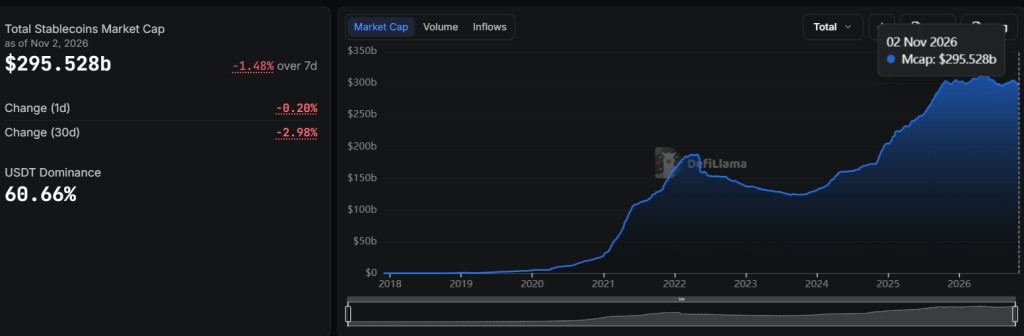
That contrast deserves attention. A stablecoin does not need its market capitalization to grow indefinitely to be useful. If the same digital dollars are used more frequently to pay for services, salaries, or suppliers, their value as financial infrastructure increases without constantly needing to attract new buyers.
Visa also reported that payment volume across its stablecoin-linked card programs grew nearly 200% year over year. The company now offers more than 160 programs, and business and commercial cards accounted for approximately 17% of the volume recorded during its 2026 fiscal year to date.
These figures remain small compared with the overall business of international payment networks, but they address a specific need: using digital balances at merchants that do not have to accept cryptocurrencies directly.
Stripe and HSBC Are Forcing Banks to Compete
Stripe is expanding stablecoin payments and, through Bridge, is working to extend its stablecoin-backed cards to more than 100 countries. Its offering allows businesses and users to benefit from blockchain infrastructure without abandoning familiar payment methods.
HSBC has taken a different approach with the launch of RedCoin, a stablecoin pegged to the Hong Kong dollar and regulated by local authorities. The product was integrated into PayMe, an application with more than 3.3 million users, to facilitate transfers and commercial payments.
RedCoin is not denominated in US dollars and operates under a regulatory framework different from the GENIUS Act. Even so, its launch is particularly noteworthy: a traditional bank decided to issue digital money for use within its own services.
This creates competition across the financial sector. Banks can develop similar products, partner with specialized companies, or continue using systems that are slower and more expensive for certain international transactions.

Regulation Could Also Undermine Competition
Institutional adoption comes at a price. The GENIUS Act restricts stablecoin issuers from paying yields, a condition that protects their role as payment instruments but limits their ability to offer financial benefits directly to holders.
There is also the problem of greater market concentration. Large companies have the resources to meet legal requirements, finance audits, and establish banking relationships. Smaller issuers could end up depending on their infrastructure or withdrawing from certain markets.
Blockchain transaction volume should not be confused with actual payments, either. Many stablecoin transfers are still associated with trading activity, internal transfers, and automated operations. Higher transaction volume does not necessarily mean more consumers are using digital dollars.
The transformation therefore has limits. Regulated stablecoins can reduce operational difficulties and expand access to international payments, but they will not eliminate fees, access restrictions, or dependence on intermediaries on their own.
Their greatest contribution may be the least spectacular: turning cryptocurrencies into technology that people use without having to think about it. For an industry accustomed to measuring success by token prices, enabling a company to pay its suppliers in digital dollars would be a far more lasting achievement.