



U.S. spot Bitcoin (BTC) exchange-traded funds (ETFs) are experiencing their worst month since they began trading in January 2024. Capital outflows challenge the expectations of those who believed that the entry of major asset managers into the cryptocurrency market would reduce BTC volatility and guarantee sustained demand.
Wall Street made Bitcoin accessible to millions of investors, but it also made it easier to liquidate their positions. The real test of institutional adoption will be determining how much capital is willing to maintain exposure to BTC during prolonged periods of losses, regardless of market conditions.

Bitcoin ETFs record historic capital outflows
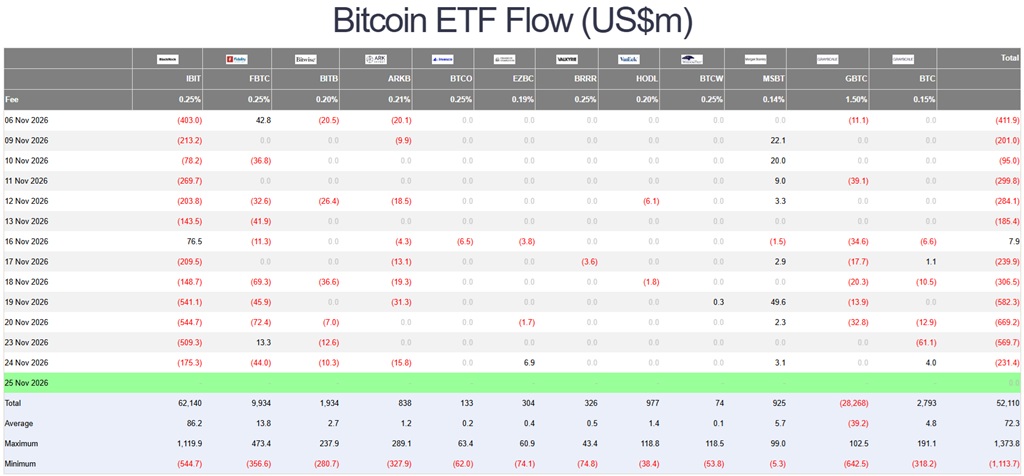
According to data compiled by TFTC, U.S. funds recorded net outflows of $569.7 million on November 23 and another $231.6 million during the following trading session.
Cumulative net outflows for November amount to approximately $4.94 billion, even though several trading sessions remain before the end of the month.
BlackRock’s iShares Bitcoin Trust (IBIT) ETF has recorded outflows exceeding $4.1 billion during this period. The product’s large market share increases the importance of its holders’ investment decisions.
However, ETF capital flow data cannot identify the motivations of investors who are liquidating their positions.
Some may be taking profits earned during 2024 and 2025, while others may be realizing losses or reducing their exposure to risk assets. Some traders also use these instruments to pursue arbitrage strategies whose profitability depends on price differences between spot and futures markets.
Attributing all ETF outflows to a loss of institutional confidence in Bitcoin would therefore be just as premature as interpreting all inflows recorded during the bull market as long-term investments.
Wall Street can also deepen Bitcoin corrections
The approval of spot ETFs by the U.S. Securities and Exchange Commission (SEC) in January 2024 removed major operational barriers for traditional investors.
Portfolio managers gained exposure to Bitcoin without having to manage private keys or develop their own cryptocurrency custody infrastructure.
That same convenience also allows them to quickly reduce exposure to BTC when financial conditions change, risk aversion increases, or managers need to reallocate capital to other investments.
The ability to sell ETF shares during regular trading hours also makes Bitcoin exposure easier to adjust alongside other holdings in a diversified portfolio.
Bitcoin competes with stocks, bonds, and other asset classes for institutional investors’ capital. Its limited supply does not exempt it from that competition or guarantee that managers will maintain their positions during a bear market.
ETFs can intensify selling pressure when redemption requests require the disposal of the Bitcoin backing their shares.
Consequently, greater participation by traditional investors will not necessarily reduce the severity of corrections. The liquidity these products provide can facilitate both market expansion and the rapid withdrawal of capital.

Institutional demand has not disappeared
Despite heavy ETF outflows in November, U.S. funds still have cumulative net inflows of $52.1 billion since their launch and manage approximately $72 billion in assets.
The distinction between these figures is important. The value of assets under management also fluctuates with Bitcoin’s price, so a decline does not necessarily equate to a withdrawal of capital.
Determining whether institutional demand has permanently weakened will require monitoring ETF flows when financial conditions improve and uncertainty in traditional markets subsides.
If investors continue withdrawing capital from ETFs even during a sustained recovery in risk assets, there will be stronger grounds for questioning Bitcoin’s acceptance as a permanent component of institutional portfolios.
For now, ETFs have fulfilled their role as instruments providing access to BTC. What needs to be abandoned is the expectation that Wall Street will provide virtually unconditional demand. Investors should assess the sustainability of that demand without assuming that the participation of major asset managers offers protection against future declines.