



While Bitcoin (BTC) and much of the altcoin market are experiencing a deep correction, some artificial intelligence (AI) tokens have posted substantial gains over the past three months. Their performance stands in stark contrast to the widespread pessimism among investors, who have reduced their exposure to cryptocurrencies amid the market downturn.
The ability of these assets to attract buyers during a period of scarce liquidity deserves closer examination. For years, the appeal of many altcoins depended on expectations of a Bitcoin recovery. However, the development of applications that integrate artificial intelligence and blockchain technology offers certain projects a growth opportunity that does not depend exclusively on BTC’s market cycle.
AI tokens defy extreme market fear
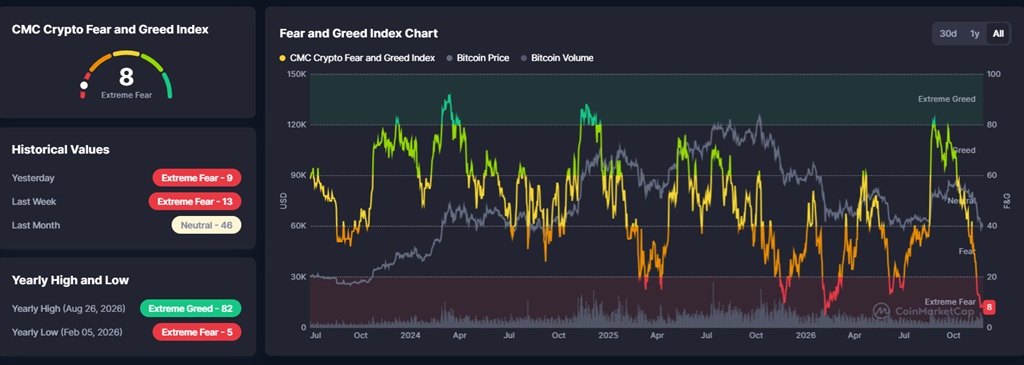
The Crypto Fear and Greed Index fell to 8 out of 100, one of its lowest readings in 2026.
Despite these conditions, according to data published by The Motley Fool, Pieverse (PIEVERSE) has gained 275% over the past 90 days. NEAR Protocol (NEAR) and Venice Token (VVV) have recorded gains of nearly 50%, while Kite (KITE) rose 22% over the same period.
The strong performance of AI tokens is not limited to the past few weeks. In its third-quarter 2026 report, CoinGecko recorded substantial gains among leading AI-related cryptocurrencies, including Bittensor (TAO), Render (RENDER), and Internet Computer (ICP).
In a bull market, it is difficult to determine whether investors are buying a cryptocurrency because of the project’s business prospects or simply because they expect to benefit from a broader increase in prices.
During a correction, available capital shrinks, and projects must compete for funding from investors who are far less willing to take risks. The ability of some AI tokens to retain their gains therefore becomes more important, although their token performance does not yet guarantee the commercial success of their applications.

The AI agent economy: new opportunities for blockchains
The development of autonomous AI agents presents a unique business opportunity for blockchain networks. Unlike conventional assistants, these systems can execute tasks, purchase services, and interact with other agents without requiring human intervention in every operation.
If these applications achieve widespread adoption, they will need infrastructure that allows them to make payments, verify identities, and access computing resources automatically.
NEAR Protocol seeks to strengthen its position in this market through infrastructure for artificial intelligence applications and cross-chain operations. Other projects are exploring the decentralized provision of computing power or access to AI models.
Blockchain networks can facilitate payments between agents operating across different jurisdictions without requiring each agent to maintain a bank account or rely on a single financial services provider.
The economic appeal comes from the ability to charge for services that other applications and businesses need to use. A protocol capable of generating recurring demand for computing resources could maintain some of its commercial activity even during a cryptocurrency market downturn.
This characteristic distinguishes AI tokens from assets whose valuations depend primarily on expectations of price appreciation.

Utility must justify AI token valuations
Enthusiasm surrounding artificial intelligence can also lead to the overvaluation of projects that still lack competitive products. Incorporating references to autonomous agents or decentralized computing into a business proposal is considerably easier than developing services capable of competing with traditional providers.
Investors will need to distinguish between an application’s growth and actual demand for its token. A platform can attract thousands of users and generate revenue without its cryptocurrency benefiting proportionally from that activity.
Competition with traditional technology companies will also be decisive for AI tokens. Decentralized solutions must offer tangible advantages in terms of cost, privacy, or accessibility to justify their use.
The next crypto market hierarchy could favor projects capable of generating economic activity independently of Bitcoin’s price fluctuations. Among AI tokens, that position will be reserved for those that successfully turn expectations surrounding artificial intelligence into services that real customers use and pay for.