



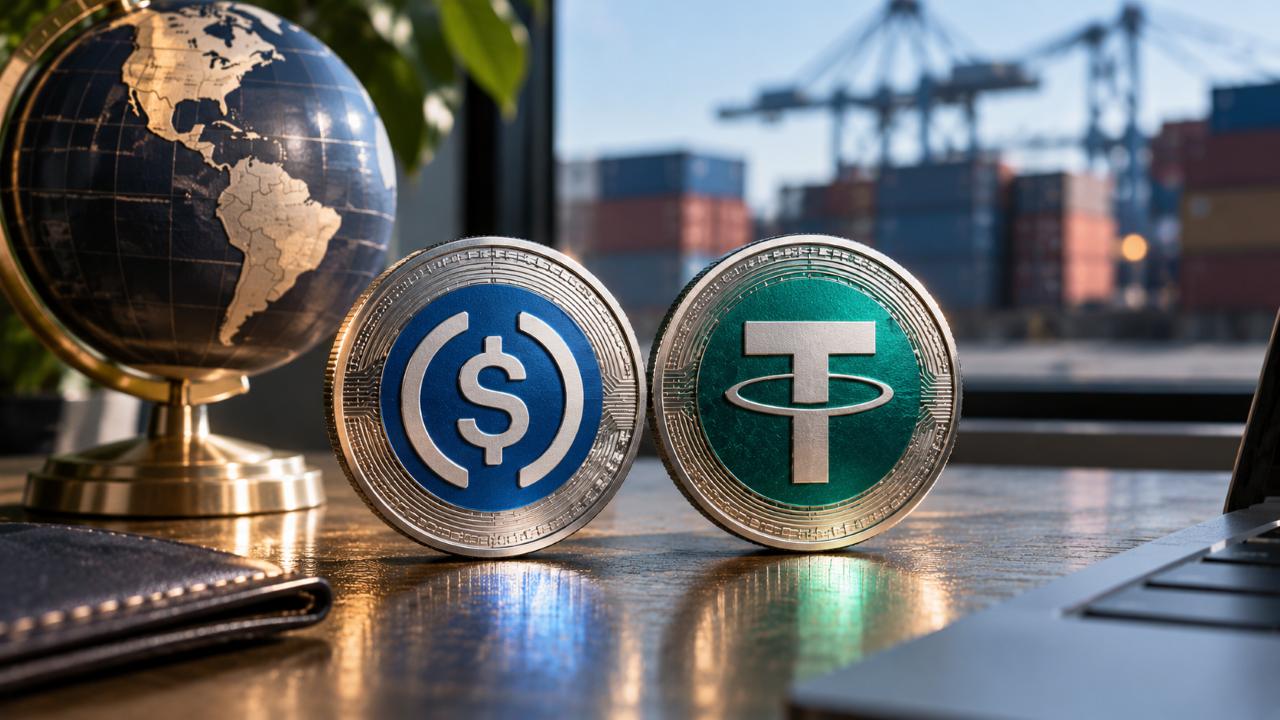
USDC and USDT are the two most widely used dollar-denominated stablecoins, but businesses evaluating them for cross-border payments should look beyond market size. The practical difference is not simply which token is larger; it is how each one connects to issuers, banking partners, blockchains, exchanges and local payout liquidity. The better choice can vary by corridor, transaction size and the recipient’s preferred network.
Both tokens are designed to track the US dollar and can move on public blockchains at any hour. That similarity makes them appear interchangeable, yet their issuance, redemption access, supported networks and regional liquidity can differ. A stablecoin that settles quickly on-chain may still be inconvenient if the recipient cannot convert it efficiently.
How USDC and USDT Enter a Payment Flow
A cross-border payment generally has three stages: the sender obtains the stablecoin, transfers it to the beneficiary and the beneficiary either holds it or converts it to local currency. The cost and reliability of all three stages determine the quality of the payment route. The blockchain transfer is often the simplest part.
USDC is issued by Circle entities and is designed for direct institutional minting and redemption through approved accounts. Circle’s USDC overview describes one-to-one redemption and native issuance across multiple networks. Direct issuer access can be valuable for regulated businesses, although eligibility and banking coverage still depend on jurisdiction and onboarding.
USDT is issued by Tether and has historically developed broad liquidity across exchanges and emerging-market trading venues. Tether’s reserve reporting provides information about the assets backing the token. USDT’s widespread secondary-market availability can make it easier to source or sell in corridors where direct issuer access is limited.
Network Availability and Transaction Costs
USDC and USDT exist on several blockchains, but the dominant network for each payment corridor may be different. USDT has substantial usage on Tron and Ethereum, while USDC is deeply integrated across Ethereum, Base, Solana and a growing set of other networks. The token symbol alone does not identify the network, fee model or settlement characteristics.
Transaction costs depend on the selected chain. A USDT transfer on Tron consumes network resources that can be obtained through staking or delegation, with TRX used to cover fees when available resources are insufficient. Ethereum and Solana use ETH and SOL, respectively, for transaction fees, while Arc’s design uses USDC itself for gas. Businesses must account for these costs, whether they pay them directly or use a platform that sponsors or abstracts fees.
The lowest nominal fee is not always the best route. A network may be inexpensive but have limited institutional custody, weaker local exchange support or lower depth for large conversions. Network selection should optimize the full payment path rather than the isolated transfer cost.

Issuance and Redemption
USDC is commonly positioned around regulated institutional access and integrated payment products. Circle’s business payment model supports obtaining USDC, transferring it and distributing value to beneficiaries through connected services. This structure can simplify treasury integration for companies that meet Circle’s onboarding requirements.
USDT is frequently accessed through exchanges, over-the-counter desks and local liquidity providers rather than direct issuer relationships. Direct redemption may involve eligibility, minimums and compliance procedures defined by Tether. Secondary-market liquidity is often the operational gateway for USDT users.
Redemption access affects risk. A business that cannot redeem directly depends on intermediaries to convert the token, which can introduce spreads, withdrawal limits and counterparty exposure. The relevant question is not whether the stablecoin is redeemable in theory, but whether the company’s actual counterparties can redeem it in practice.
Reserve and Counterparty Considerations
Both stablecoins depend on centralized issuers and reserve assets. Holders rely on the issuer’s ability to maintain liquidity, manage banking relationships and honor eligible redemptions. Neither USDC nor USDT is equivalent to an insured bank deposit.
Circle publishes reserve information and presents USDC as fully reserved with cash and cash-equivalent assets. Tether publishes periodic attestations covering reserve composition and excess reserves. The two reporting frameworks should be reviewed on their own terms rather than treated as identical. Businesses should examine the reporting entity, frequency, reserve categories and redemption obligations.
Counterparty risk also extends to exchanges, custodians and payment processors. A company may hold a stablecoin issued by a solvent entity but still lose access because an intermediary freezes withdrawals or suffers an operational failure. Stablecoin risk is a chain of dependencies, not a single issuer assessment.
Cross-Border Liquidity and Local Conversion
USDT often has an advantage in markets where crypto exchanges and peer-to-peer venues use it as the primary dollar trading pair. That can reduce the number of conversions required for the recipient. USDT may be more practical when local liquidity is the decisive factor.
USDC can be preferable where regulated institutions, fintech platforms or corporate treasury providers have direct integrations with Circle. It may also offer cleaner native transfer pathways between supported chains through Circle’s infrastructure. USDC may be more practical when issuer connectivity and institutional controls matter most.
The correct comparison should use real quotes from the relevant corridor. A business should measure the amount of local currency received after spreads, network fees, exchange charges and payout costs. The token with the lower on-chain fee can still deliver less value after conversion.
Settlement Speed and Finality
Both USDC and USDT can move quickly, but settlement time is determined mainly by the blockchain and the receiving platform’s confirmation policy. A transfer can appear in a wallet before an exchange credits it for trading or withdrawal. Blockchain speed and platform availability are separate variables.
Cross-chain transfers add another layer. USDC can move through Circle’s burn-and-mint infrastructure on supported routes, while USDT transfers across networks often depend on exchanges, third-party bridges or liquidity providers. USDC transfer-time guidance illustrates how finality differs by chain. A cross-chain route should be assessed for bridge risk, completion time and destination liquidity.

Compliance and Address Controls
Both issuers operate centralized controls that can restrict addresses under legal or compliance requirements. A stablecoin transfer is permissionless at the network level only within the limits of the token contract and issuer policies. Businesses should account for sanctions screening, wallet risk scoring and the possibility of freezes.
The compliance burden does not disappear when a payment moves on-chain. Customer identification, invoice validation, source-of-funds checks and transaction monitoring may still apply. Stablecoins change the payment rail, not the company’s legal obligations.
USDC may fit more naturally into environments that prioritize documented institutional onboarding, while USDT may be more accessible through broad exchange liquidity. The practical distinction lies in the available access channels, counterparties and institutional integrations. Neither token guarantees regulatory compliance, and neither access model is universally superior.
Operational Risks by Network
Businesses must verify that the recipient supports the exact token contract and network. Sending Ethereum USDT to a Tron deposit address, or bridged USDC to a platform that accepts only native USDC, can create recovery problems. Ticker symbols are not sufficient payment instructions.
Issuer support can also change. Tether has discontinued direct issuance and redemption on some legacy networks while allowing existing tokens to continue transferring, as described in its legacy-blockchain transition notice. A supported token can become operationally stranded if exchanges and issuers withdraw network services.
A corporate policy should therefore maintain approved contract addresses, networks and counterparties. Test transactions and address whitelists are particularly important for first-time routes. Payment controls should be specific to the token-network pair, not only the stablecoin brand.

When USDC May Be the Better Choice
USDC may be preferable when the company has direct or well-integrated access to Circle, needs documented institutional workflows or wants native cross-chain transfer tools. It can be a strong fit for fintech, treasury and payment providers operating within supported regulatory and banking corridors.
It may also suit recipients who already use USDC-based applications, custody platforms or settlement networks. The benefit decreases when the final recipient must convert through thin local markets. USDC’s institutional structure is most valuable when the surrounding infrastructure is available to both sides.
When USDT May Be the Better Choice
USDT may be preferable where local exchanges, merchants and liquidity providers already treat it as the standard digital dollar. Its broad market depth can reduce conversion friction in corridors dominated by USDT trading pairs.
That advantage should be balanced against direct redemption access, network support and the company’s compliance requirements. A treasury team may decide that the deepest local liquidity outweighs the absence of a direct issuer relationship. The decision should be based on executable payment routes rather than global market capitalization alone.
Conclusion
The USDC vs USDT payments decision is operational rather than ideological. USDC often emphasizes issuer-integrated institutional access, while USDT often offers broader secondary-market liquidity. The most efficient token depends on the network, recipient, local exchange depth and conversion partners involved.
Businesses should compare the amount delivered after all costs, the time to usable settlement, redemption access and the legal controls around the route. The best cross-border stablecoin is the one that completes the full payment chain reliably at an acceptable risk-adjusted cost. Many companies will ultimately support both tokens and select between them on a corridor-by-corridor basis.