


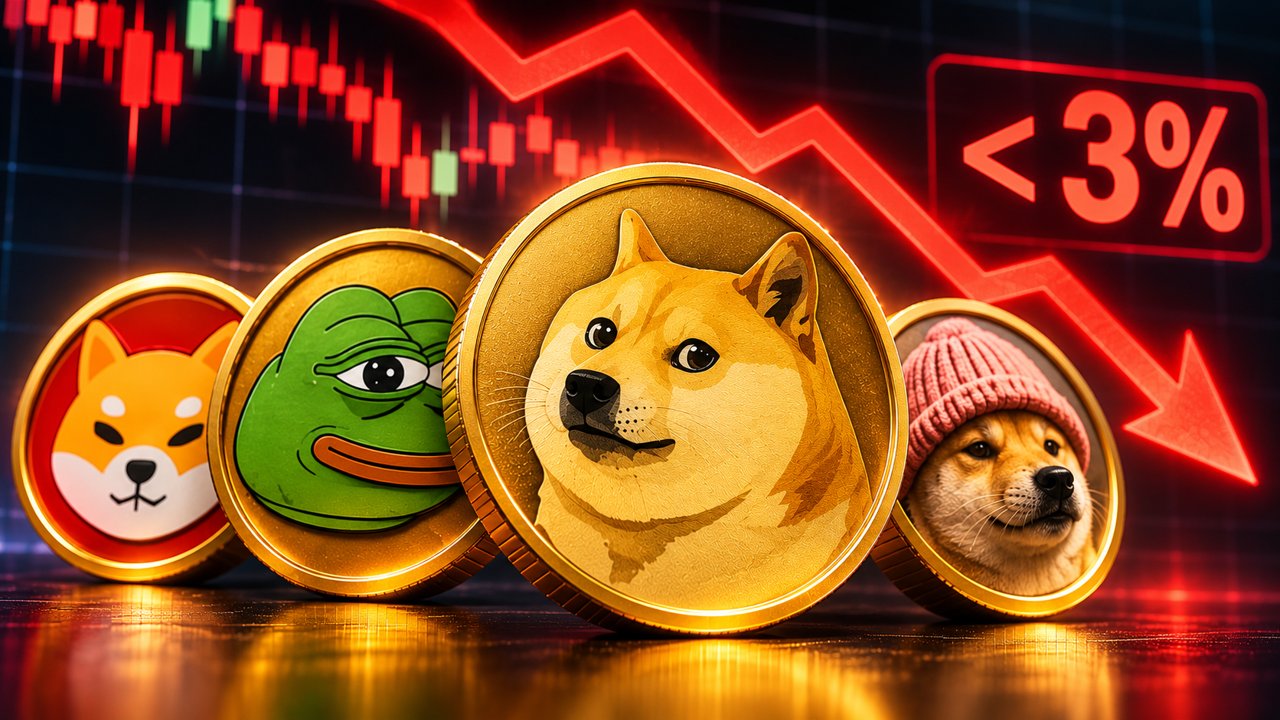
The memecoin market is experiencing its worst period since the speculative boom that defined the crypto industry throughout 2024 and 2025. These assets have lost much of their share of the altcoin market and are finding it increasingly difficult to attract buyers, even during Bitcoin’s (BTC) attempts to recover.
During the last bull cycle, the possibility of multiplying an investment within hours made memecoins one of the industry’s biggest attractions. However, scarce liquidity and fading interest among retail traders are bringing an end to a model that relied almost exclusively on speculation and social media popularity.
The memecoin market loses ground to other altcoins
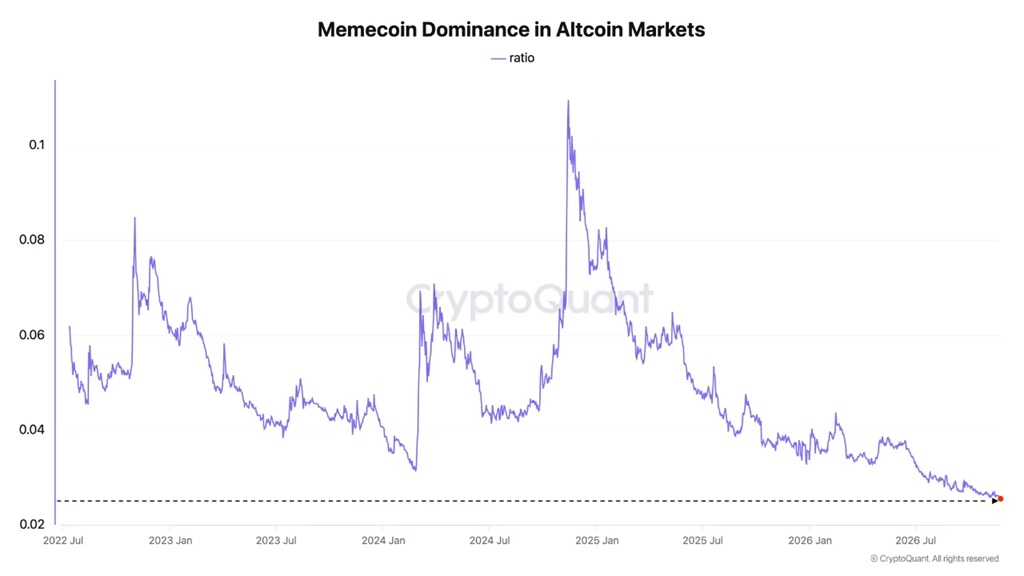
According to a CryptoQuant report, memecoins’ share of the altcoin market capitalization fell from 11% in November 2024 to 2% today, its lowest level on record.
On Binance, cumulative selling volume for these assets exceeds buying volume by approximately $1.5 billion. Selling pressure has persisted since October 2025.
The altcoin market has lost $408 billion in market capitalization since its last peak in September. At the time, 90% of the altcoins available on Binance were trading above their 200-day moving average. Currently, only 19% remain above that indicator.
Although the correction affects virtually the entire market, the decline in memecoin market share indicates that these assets are experiencing a proportionally greater deterioration than the rest of the sector.
During periods of abundant liquidity, traders were willing to take extraordinary risks in exchange for the possibility of equally high returns. Today, it is much harder to justify exposure to assets whose demand depends on a constant influx of new buyers.
The exhaustion of an attention-driven model
The ease of creating and trading new tokens allowed thousands of memecoins to compete simultaneously for traders’ capital. Launchpads simplified the creation process to the point where virtually any user could issue their own cryptocurrency.
The problem with this model is that the ability to issue new assets is practically unlimited, but the amount of capital available to speculate on them is not.
Every successful launch encouraged new competitors to emerge in an attempt to replicate its returns. The result was a fragmentation of liquidity across thousands of tokens with few differences between them.
A memecoin did not even need to lose its popularity entirely for its price to start falling. All it took was another asset capable of capturing its community’s attention and attracting its buyers.
Regulation can hardly be considered the main reason behind the deterioration of this segment. In February 2025, the U.S. Securities and Exchange Commission (SEC) itself issued a statement in which its staff stated that transactions involving typical memecoins did not involve securities subject to federal securities laws.
The market is reducing its exposure to these assets on its own, without the need for direct intervention from regulators.

Which memecoins can survive the changing market cycle?
The declining prominence of memecoins does not necessarily mean they will disappear. Projects such as Dogecoin (DOGE) have survived several bear cycles thanks to established communities, a recognizable identity, and some degree of adoption as a means of payment.
However, newer tokens will find it much harder to compete for capital with projects that offer decentralized financial services, blockchain infrastructure, or applications capable of generating revenue.
Even among these projects, a protocol’s utility does not guarantee that its token is a good investment. Investors must also evaluate how revenue is distributed, the issuance of new tokens, and the relationship between product usage and demand for its cryptocurrency.
New periods of speculative euphoria may emerge, but expecting memecoins to lead another bull cycle means counting on millions of traders returning to a market saturated with virtually interchangeable assets. Popularity can still generate extraordinary short-term gains, but it is unlikely to sustain the valuation of an entire category of cryptocurrencies on its own.