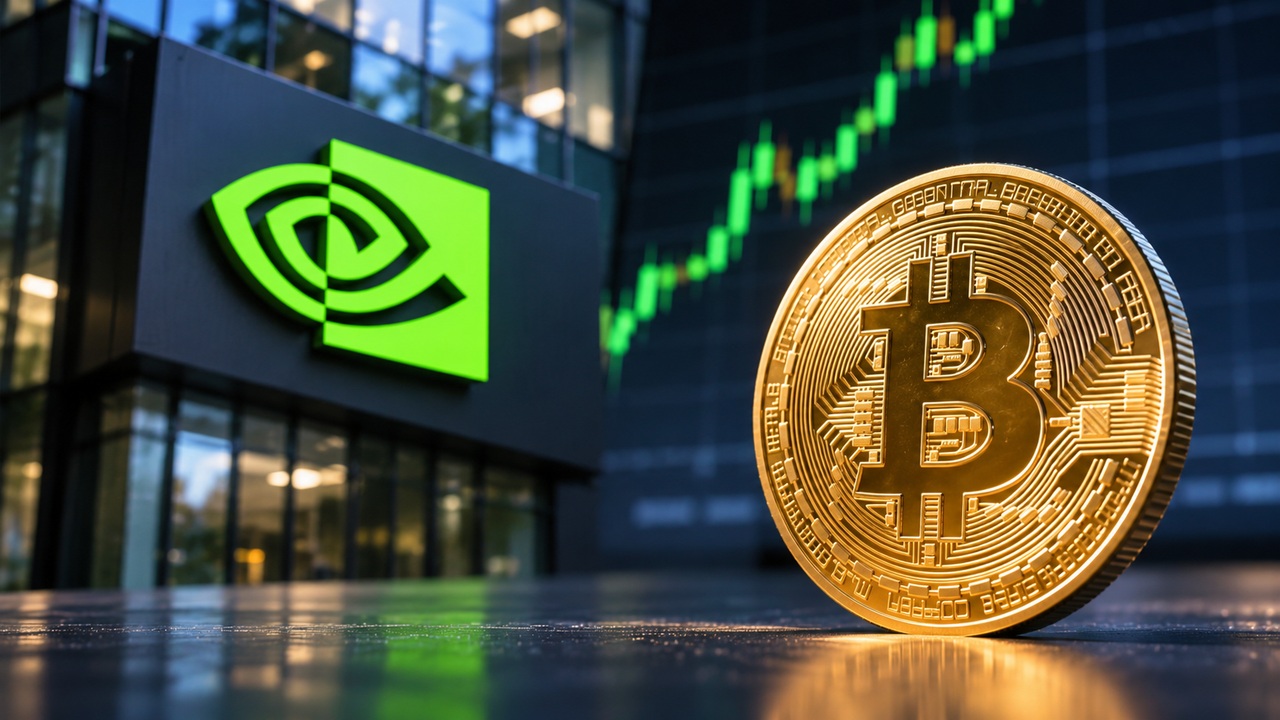
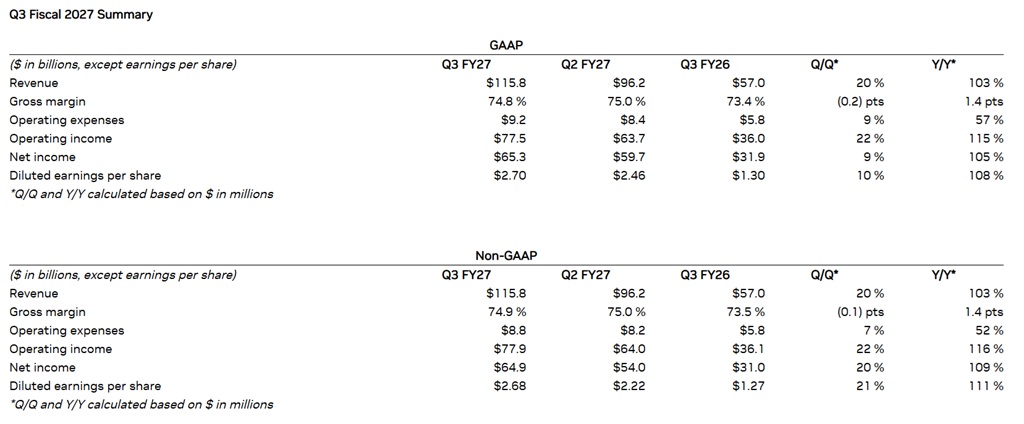
Nvidia reported quarterly revenue of $115.8 billion, doubled its year-over-year sales, and exceeded Wall Street expectations. Nasdaq futures rose, but Bitcoin failed to hold on to its initial gains.
BTC briefly climbed above $64,600, but gave up much of that increase in approximately 35 minutes.
Its performance is uncomfortable for those who argue that Bitcoin should automatically benefit from the growth of artificial intelligence and enthusiasm for technology companies.
The lack of a sustained reaction does not prove that Bitcoin has decoupled from the Nasdaq. It could also indicate that buyers have less capacity or willingness to take risks.
That second explanation deserves greater attention while the cryptocurrency market remains weak.

Nvidia Beat Expectations, but Bitcoin Failed to Follow
According to Nvidia’s official financial results, revenue increased 103% year over year and 20% from the previous quarter.
The data center business generated $107.6 billion, driven by demand for artificial intelligence infrastructure.
The company also projected revenue of approximately $130 billion for the following quarter, above analysts’ estimates.
Nasdaq 100 futures rose after the announcement, and Nvidia shares climbed in premarket trading. Bitcoin, however, failed to sustain its recovery.
Over the past several years, investors have frequently associated cryptocurrencies with technology stocks: both markets can benefit when risk appetite increases.
However, sharing certain financial drivers does not mean responding identically to every piece of news.
Nvidia’s profits belong to its shareholders. Bitcoin receives no revenue from processor sales and does not directly participate in artificial intelligence infrastructure contracts.
That is why expecting BTC to rise automatically after every positive Nvidia earnings report lacks a sufficient economic basis.
The Liquidity Behind Bitcoin’s Weakness
A more convincing explanation lies in conditions within Bitcoin’s own market.
When available liquidity declines, buying activity has greater difficulty sustaining a recovery. Prices also become more sensitive to relatively large orders.
The problem can worsen when traders reduce leveraged positions and withdraw trading volume from derivatives markets.
In particular, strategies known as basis trades seek to profit from the difference between Bitcoin’s spot price and its futures price.
When that spread narrows, the strategy’s potential profitability declines. Some traders may close positions or allocate capital to other markets.
A compression in futures spreads can reduce certain incentives to maintain positions, although that alone does not establish that it caused Bitcoin’s decline.
The recent weakness cannot be attributed exclusively to these mechanisms either. Assessing their contribution would require comparing spreads, open interest, and market depth over the same period.
The important point is that positive news for technology stocks does not necessarily compensate for a lack of demand within the cryptocurrency market.

Bitcoin’s Independence Still Needs to Be Proven
There is an optimistic interpretation: if Bitcoin stops reacting to Nvidia’s gains, it may be developing its own market dynamics.
That would be a welcome development for an asset that aims to offer an alternative to traditional financial instruments.
But independence cannot be assessed only when stocks rise.
A more demanding test would be whether Bitcoin can also hold up when the Nasdaq falls, particularly during periods of reduced liquidity or greater monetary uncertainty.
If BTC ignores positive developments in the technology sector but continues to suffer during its corrections, investors would face an unfavorable relationship.
Observing just a few hours of trading is not enough, either. Correlations change depending on the period examined and can increase precisely during broad market sell-offs.
That is why an isolated reaction to Nvidia’s earnings does not justify declaring that Bitcoin has moved beyond its behavior as a risk asset.

The Market Needs Demand of Its Own
BTC’s instability coincides with the expected release of minutes from the Federal Reserve’s latest meeting, which could provide information about the outlook for interest rates.
Monetary conditions matter because they affect borrowing costs and the returns available on assets considered safer.
However, Bitcoin should not have to depend on a positive surprise from Nvidia to attract buyers again.
Its recovery requires demand capable of sustaining higher prices without relying exclusively on enthusiasm for other industries.
Nvidia’s results confirmed the strength of its business. Bitcoin’s reaction, by contrast, showed that good news for artificial intelligence is not enough to resolve the weaknesses of the cryptocurrency market.