




Bitcoin trades around the clock, but the exchange-traded funds (ETFs) providing traditional investors with exposure to the asset do not. While spot cryptocurrency markets remain active 24 hours a day, seven days a week, U.S.-listed spot Bitcoin ETFs adhere to rigid equity exchange schedules—with core trading on Nasdaq and NYSE Arca running strictly from 9:30 a.m. to 4:00 p.m. Eastern Time.
This structural mismatch creates distinct operational windows during which underlying Bitcoin prices move substantially while ETF shares remain static, fundamentally changing how price discovery and market liquidity function.
Bitcoin Price Moves Outside ETF Trading Sessions
Overnight and Weekend Moves Affect ETF Openings
When spot Bitcoin experiences sharp volatility overnight, during weekends, or over market holidays, traditional ETF shares cannot react in real time. Consequently, when U.S. markets reopen, fund shares frequently experience significant price gaps relative to their previous close to adjust to the updated spot market valuation.
Rather than driving these movements, ETFs in these scenarios simply reflect developments that transpired first in the continuous spot market. Institutional traders, fund managers, and market makers closely monitor global crypto exchanges outside U.S. market hours, knowing that significant overnight moves will translate into elevated trading volume and wider bid-ask spreads at the opening bell.
ETF Trading Influences Bitcoin During U.S. Hours
Conversely, the relationship operates in reverse during U.S. business hours. Macroeconomic releases, Federal Reserve policy updates, and institutional capital shifts during equity market sessions trigger immediate ETF trading activity. Sustained net inflows into spot ETFs generate concentrated buying pressure in the underlying spot market, while heavy outflows amplify selling pressure.
This creates an interconnected dual structure: Bitcoin maintains a continuous, global baseline of trading activity, punctuated by concentrated bursts of institutional volume during U.S. exchange hours.
Liquidity Shifts Between Crypto Markets and Bitcoin ETFs
Understanding the market dynamics between spot Bitcoin and financial derivatives requires analyzing their distinct liquidity profiles. Continuous crypto liquidity moves fluidly across Asian, European, and North American time zones. ETF liquidity, by contrast, concentrates heavily within standard U.S. market hours.
Authorized Participants Maintain Pricing Alignment
To bridge pricing gaps between continuously trading spot markets and scheduled ETF shares, institutional market makers acting as Authorized Participants (APs) rely on creation and redemption mechanisms.
In July 2025, the U.S. Securities and Exchange Commission approved in-kind creations and redemptions for crypto exchange-traded products (ETPs). This regulatory shift allowed APs to exchange underlying Bitcoin directly for fund shares rather than relying exclusively on cash transactions, significantly boosting arbitrage efficiency and helping keep ETF market prices tightly aligned with net asset values (NAV).
However, during periods of extreme weekend or overnight volatility, temporary premiums or discounts can still emerge upon market open as liquidity providers recalibrate their positions.
Expanded Market Access via Traditional Brokerages
By removing the operational hurdles of managing private keys, setting up crypto exchange accounts, or navigating self-custody, spot ETFs have integrated Bitcoin exposure directly into standard brokerage accounts. This integration allows traditional asset managers, financial advisers, and retail portfolios to participate in Bitcoin price discovery alongside native crypto venues.
Market Participants Adjust to Continuous Dynamics
Traders can no longer evaluate Bitcoin within the vacuum of a single market session. Price action in Asian or European hours frequently sets the trajectory for the U.S. opening, while institutional demand during Wall Street hours reverberates globally.
Recent Rallies Demonstrate Rapid Market Shifts
A clear example of this dynamic occurred on August 20, 2026, when Bitcoin surged above $75,500 during a sharp market advance. According to The Block and Reuters, the rally was triggered by the U.S. Treasury Department’s announcement to expand buybacks of longer-duration government debt, alongside positive crypto policy developments in Washington.
The event highlighted Bitcoin’s ability to price in macroeconomic and regulatory news instantaneously, without waiting for equity markets to open.
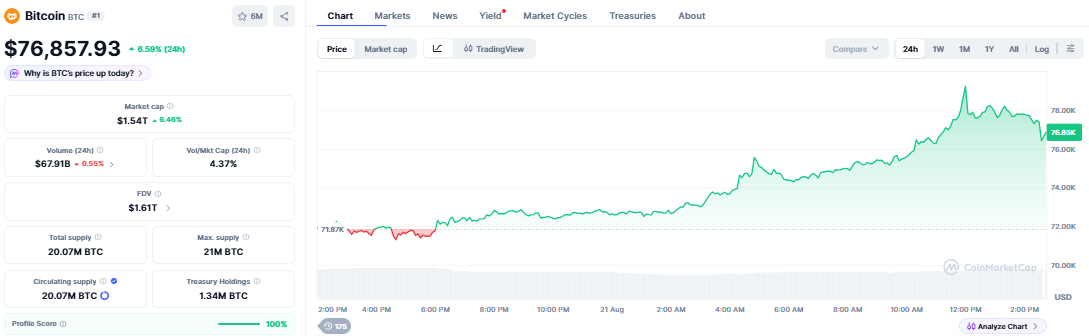
Leveraged derivatives further accelerated the move. Citing CoinGlass data, The Block reported that over $2.75 billion in Bitcoin short positions were liquidated during the initial stage of the rally, followed by an additional $783.2 million in total position liquidations over the next 24 hours—roughly $747.7 million of which were forced short covers. This leverage unwind demonstrated how rapid spot moves cascade across derivative and ETF markets alike.
What the 24/7 Trading Gap Means for Investors
The integration of Bitcoin into traditional exchange-traded products has not erased the fundamental differences between crypto and legacy financial markets. Bitcoin remains a 24/7 global asset, while ETFs operate within structured exchange windows.
For institutional and retail investors, understanding this multi-layered environment is critical. Crypto exchanges set continuous global pricing; ETFs inject concentrated institutional volume during U.S. hours; and derivatives markets introduce leverage and liquidation dynamics. Navigating this timing gap will remain a central feature of crypto market structure as institutional adoption matures.