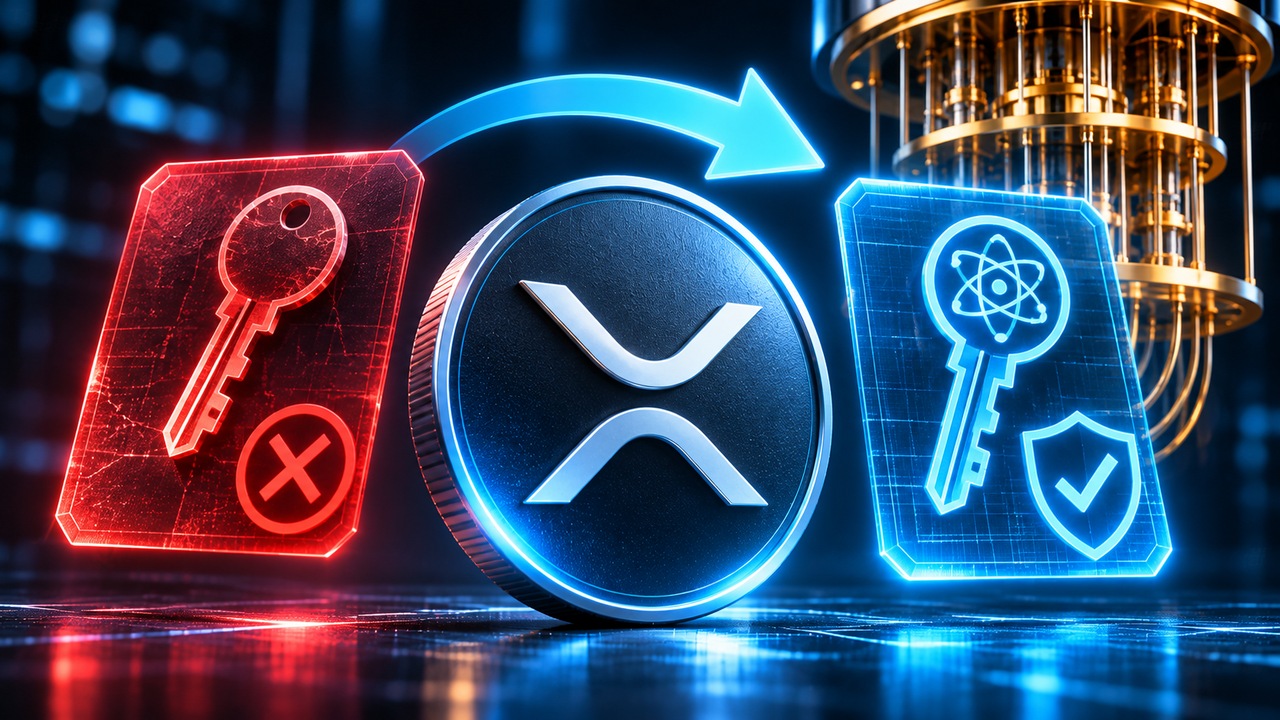
The XRP Ledger is preparing an upgrade to protect its accounts against future quantum computer attacks. The proposal introduces cryptographic signatures resistant to these threats, but places a critical responsibility on account owners: they will need to replace their current keys and disable the old ones to protect their funds.
The XRP Ledger Foundation’s roadmap includes a migration study during the first half of 2027, followed by development and technical audits. Ripple, meanwhile, maintains its goal of completing the transition to post-quantum cryptography by 2028.
The challenge goes beyond developing a secure system. It also involves getting millions of users, exchanges, and custodians to change how they access their accounts before quantum computers become capable of breaking today’s cryptography.

XRP Ledger Can Upgrade Its Technology, but Not Its Users’ Decisions
The XRP Ledger’s technical proposal introduces ML-DSA-44, a signature algorithm standardized by the U.S. National Institute of Standards and Technology (NIST).
This mechanism would allow users to add a quantum-resistant key to an existing account. However, doing so would not guarantee complete protection.
If the traditional master key remains enabled, an attacker could use it to take control of the account, even after the new signature has been added.
This detail turns a cryptographic upgrade into a coordination problem. Exchanges can organize centralized migrations, and major custodians have dedicated technical teams. Individual users, however, depend on the tools provided by their wallets and on correctly understanding the procedure.
An incomplete migration could create a contradiction: a network prepared to withstand quantum attacks while some of its funds remain protected by vulnerable keys.
Quantum-Resistant Signatures Also Shift Costs to Infrastructure
The XRP Ledger’s proposed design aims to maintain current transaction fees, even though the new signatures require considerably more space.
According to the Foundation’s feasibility study, a transaction protected by ML-DSA-44 would occupy approximately 5,331 bytes, compared with the 1,704 bytes used as a reference for a conventional payment.
This means validators and operators would need to process and store more data without necessarily receiving higher fees.
XRP Ledger still needs to resolve compatibility issues between implementations and conduct performance tests with validators using the new signatures.
The additional security therefore requires technical investments that do not disappear simply because users continue paying the same transaction fees.

The Real Challenge
Ripple’s plan acknowledges that every time an account signs a transaction, its public key becomes exposed on the blockchain. A sufficiently powerful quantum computer could use that information to attempt to recover the private key.
The risk particularly affects accounts that have been active for years, including those used by exchanges and custody providers.
But there is no established date for the quantum threat to materialize. The 2028 target represents a technology roadmap, not a prediction of when computers capable of carrying out these attacks will become available.
That is precisely why voluntary migration presents a problem. Users often postpone security changes when the threat still seems distant, especially when the procedure requires modifying keys that control financial assets.
XRP Ledger could develop a technically sound solution and still leave accounts vulnerable for years. No consensus upgrade guarantees that account owners will adopt the new tools.
The Foundation will need to determine how to make the transition easier, what happens to accounts that never replace their keys, and how to prevent mistakes that could lock users out of their funds.
XRP Ledger’s readiness will depend on more than its cryptography. It will also depend on how many users actually complete the migration.