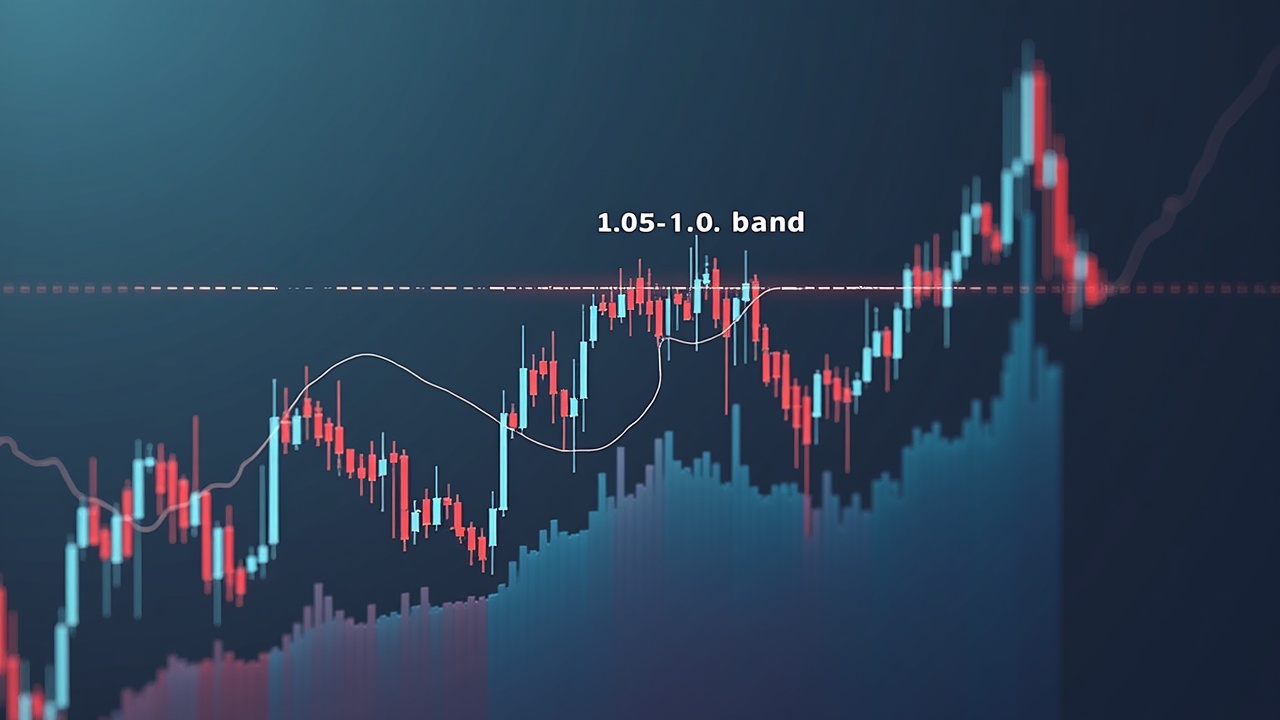
XRP drifted toward the $1.05 to $1.10 support band after three weeks of tight consolidation, leaving traders divided over whether the setup will resolve as a rebound or a breakdown. The compression has turned a narrow trading range into a decisive technical battleground.
Volume and ETF flow data sharpened the debate between June 20 and June 23, 2026. A June 22 reversal lifted trading volume to about 65.4 million XRP, roughly 84% above average, while XRP ETFs recorded around 2.4 million in inflows on June 20, giving bulls fresh evidence of demand near support.
Bulls Point to Accumulation Near $1.10
The bullish case centers on accumulation and improving momentum indicators. Commentators cited a recovering Relative Strength Index, a flattening Ichimoku cloud and converging short-term moving averages as signs that a short-term bottom could be forming near $1.10.
Supporters of the rebound thesis also pointed to the market’s ability to absorb recent selling without a decisive breakdown. If XRP clears the current range with follow-through, upside targets cited by analysts sit in the $1.36 to $1.64 area.
The ETF inflows added another layer to that view. While the reported June 20 inflow was modest, it helped reinforce the argument that some buyers are willing to step in during consolidation rather than wait for confirmation.
Still, the bullish thesis depends heavily on volume. A breakout above the $1.18 to $1.30 supply zone would need stronger transaction flow to confirm a genuine shift from compression to upside continuation.
Bears Warn of Weak Buying Conviction
The bearish case focuses on XRP’s failure to reclaim higher support-turned-resistance levels. Analysts flagged weekly structure and moving averages as negative, arguing that the market has not yet shown enough conviction to reverse the broader pressure.
XRP was also trading below a long-term exponential moving average, a signal that bearish commentators treated as a structural warning. A decisive break below $1.05 could open a path toward the $0.70 to $0.80 downside zone.
Some veteran chartists cited an intermediate technical projection near $0.75 if support fails. That level would represent a deeper reset from the current consolidation range and likely force traders to reassess short-term risk exposure.
Signals suggest low volatility may be masking weaker underlying participation, rather than simply preparing the market for a bullish breakout.
The key is to monitor volume-weighted price action around $1.05 to $1.10 and size positions around the asymmetric risk defined by the current range.
A sustained move above $1.18 to $1.30 would likely shift short-term bias toward buyers. A confirmed breach below $1.05, however, would likely accelerate downside pressure and turn support failure into the market’s dominant signal.