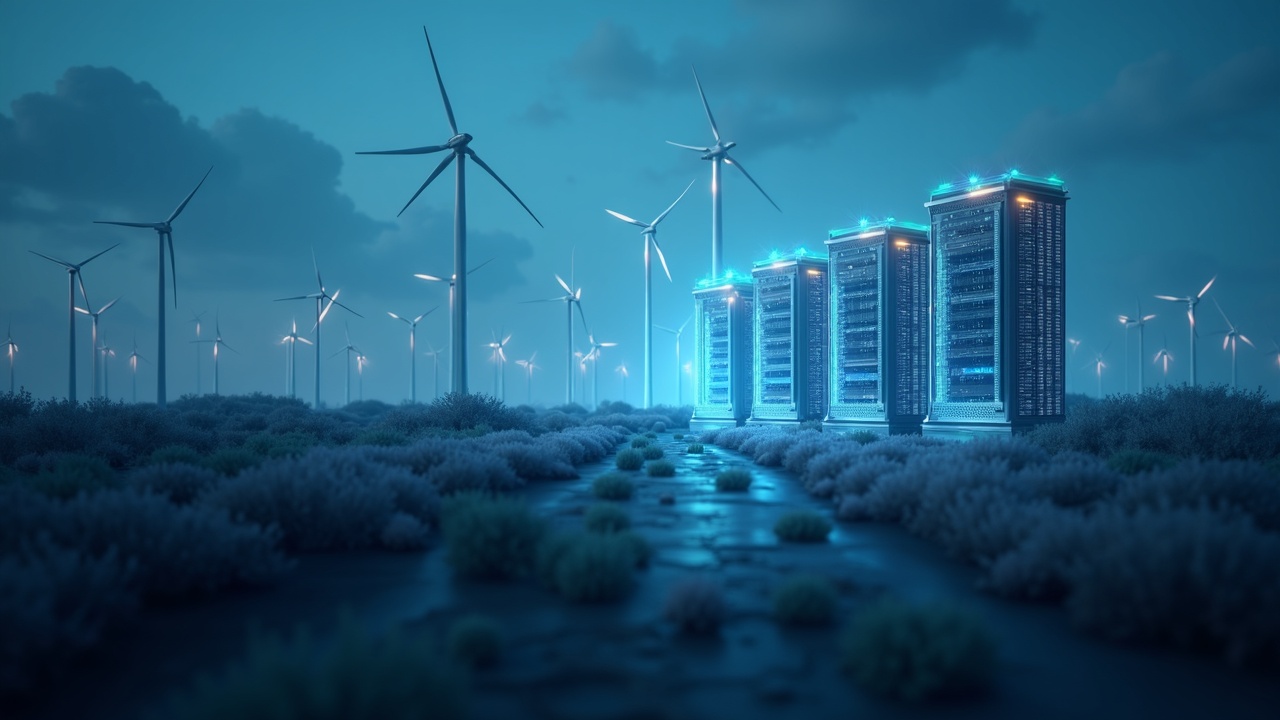
Soluna Holdings closed its $53 million acquisition of the 150 MW Briscoe Wind Farm, giving the company direct control over a major power asset tied to its broader compute strategy. The transaction marks a decisive step in Soluna’s push to vertically integrate energy generation with digital infrastructure at its Project Dorothy site.
The company said the deal will support faster deployment of AI and high-performance computing capacity while also strengthening the economics of its renewable-powered Bitcoin operations. By bringing generation in-house, Soluna is trying to reduce dependence on outside power arrangements and gain tighter control over one of the most important inputs in its business model.
Owning the power source changes the development timeline
The Briscoe Wind Farm will sit at the center of Soluna’s next phase of expansion around Project Dorothy. The acquisition is meant to support the planned Dorothy 3 AI campus, located near Dorothy 1 and 2, and to provide on-site renewable generation that can serve both AI workloads and Bitcoin mining.
That matters because Soluna is framing the purchase not only as an energy deal, but as a speed-to-power solution. Owning the generation asset allows the company to bypass some of the delays that come with third-party power purchase agreements and long interconnection queues, both of which can slow the rollout of energy-intensive compute projects.
Management has tied that advantage directly to near-term financial expectations. Company materials project first-year adjusted EBITDA of $6 million to $11 million and annualized revenue of $20.0 million to $24.4 million from the Briscoe asset, reinforcing the idea that the purchase is expected to contribute immediately rather than only over the long term.
The strategy links AI demand with energy control
The deal also reflects broader market conditions that are reshaping infrastructure decisions. As AI and HPC demand accelerates, access to reliable and reasonably priced power has become a strategic constraint rather than a background operating cost.
That is especially relevant in Texas, where large-scale data-center development is intensifying and competition for capacity is rising. Soluna’s argument is that direct ownership of renewable generation can create a structural advantage by reducing exposure to volatile wholesale power prices, contract counterparty risk, and bottlenecks tied to shared grid access.
The company financed the acquisition with $12.5 million of debt from Generate Capital and its own cash, giving it control of a 150 MW asset that also supports its broader long-term development plans. Those plans include land adjacent to Dorothy 1 and 2 that could support a 300 MW-plus AI campus on a 300-acre parcel, assuming interconnection and on-site generation progress as expected.
In that sense, the Briscoe purchase is about more than immediate cash flow. It pushes Soluna further away from a co-location model and closer to a fully integrated renewable-compute platform built around energy ownership, infrastructure control, and diversified workload demand.
The next test will be execution. If interconnection expansion and on-site generation development move forward on schedule, the acquisition could shorten Dorothy 3’s deployment timeline and help lock in a more durable cost structure for AI, HPC, and Bitcoin operations.