




Bitcoin (BTC) reclaimed the $60,000 level after falling to nearly $57,500. However, its daily chart displays a technical pattern known as the Death Cross, which is often associated with prolonged periods of weakness.
The emergence of this signal, combined with widespread pessimism and record capital outflows from U.S. ETFs, makes it difficult to regard the recent recovery as the beginning of a new bullish trend. Buyers still need to demonstrate that they can sustain prices once speculative activity in the derivatives market subsides.

Bitcoin displays a bearish technical pattern
According to an analysis published by PrimeXBT, Bitcoin’s 50-day exponential moving average (EMA) crossed below its 200-day counterpart. Both are trending downward.
The former stands at approximately $71,478, while the latter sits at $74,516. The gap between current prices and these levels presents a considerable obstacle for buyers.
The Death Cross has an important limitation: it is calculated using historical prices and can appear when much of the damage has already been done. The pattern cannot determine how long a bearish trend will last or how severe subsequent price declines might be.
However, dismissing this signal solely because it is a lagging indicator would be imprudent. The downward trajectory of both moving averages indicates that Bitcoin’s weakness extends across different trading periods and cannot be attributed exclusively to selling pressure over the past few days.
During previous bear markets, investors had numerous opportunities to purchase BTC at prices below recent highs. Many of those discounts proved insufficient to offset the losses they suffered over the following months.
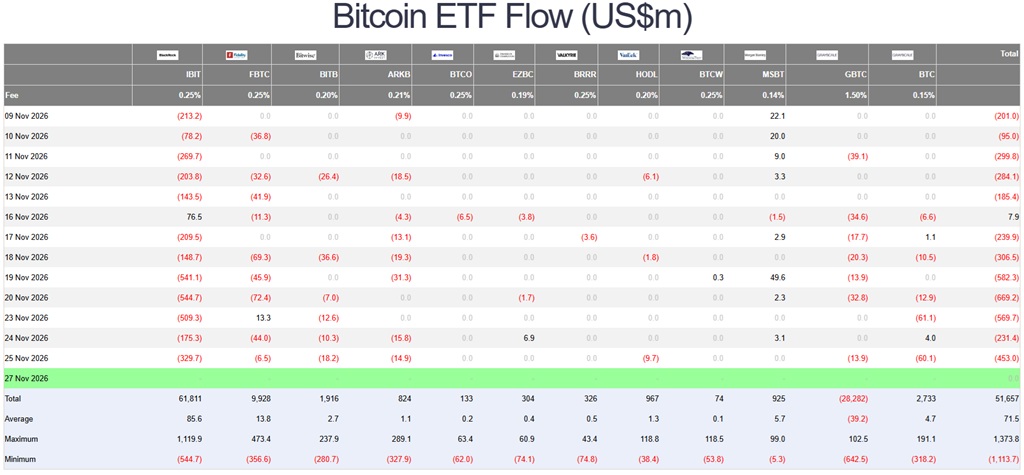
A shortage of buyers threatens BTC’s recovery
U.S. spot Bitcoin ETFs accumulated approximately $5.39 billion in net outflows during November through the 25th, according to data from Farside Investors.
Weak capital flows also make it more difficult for the cryptocurrency market to absorb renewed selling pressure. A price recovery without an expansion in the liquidity available through stablecoins would be considerably more difficult to sustain.
The closure of U.S. stock markets during Thanksgiving reduced participation among traditional traders. Under these conditions, short-position liquidations can drive substantial increases in Bitcoin’s price without requiring large capital inflows.
Traders purchasing BTC during these rebounds risk encountering a new wave of selling once investors holding bearish positions finish adjusting their contracts.
The cryptocurrency market’s Fear and Greed Index remains in extreme fear territory. Although such periods have historically offered buying opportunities, pessimism can persist for months before a sustained recovery in demand materializes.

What does Bitcoin need to reverse its bearish trend?
Reclaiming the range between $62,000 and $64,000 would represent an initial test for buyers. Breaking above these levels alongside an increase in spot trading volume would carry greater weight than a rally driven primarily by liquidations.
It would also be worth monitoring whether Bitcoin manages to establish higher lows over the coming weeks and whether its moving averages begin to stabilize.
Investors should also distinguish between a temporary reduction in selling pressure and the emergence of sustained buying interest. The absence of aggressive sellers does not necessarily mean that buyers are prepared to commit substantial amounts of capital at higher prices.
Waiting for a complete reversal of the bearish crossover could mean missing a considerable portion of an eventual recovery. Using this indicator as the sole criterion for determining when to purchase cryptocurrencies would therefore be equally unreasonable.
The question is how much capital investors should expose while the conditions that have contributed to the downturn persist on time. Aggressively increasing leveraged positions before spot demand recovers means taking risks that are difficult to justify on the basis of a rebound lasting only a few trading sessions.