




Bitcoin exchange-traded funds (ETFs) promised to transform the relationship between financial institutions and the cryptocurrency market. Their arrival gave major investors easier access to BTC and fueled expectations that institutional capital would bring greater stability. However, recent outflows are now calling that assumption into question.
The problem is not that ETFs experience capital outflows. Every financial instrument goes through periods of inflows and redemptions. The real question is whether these products are attracting investors committed to Bitcoin for the long term or simply making it easier for capital to enter and exit in response to market conditions.
BlackRock leads more than $4 billion in capital outflows
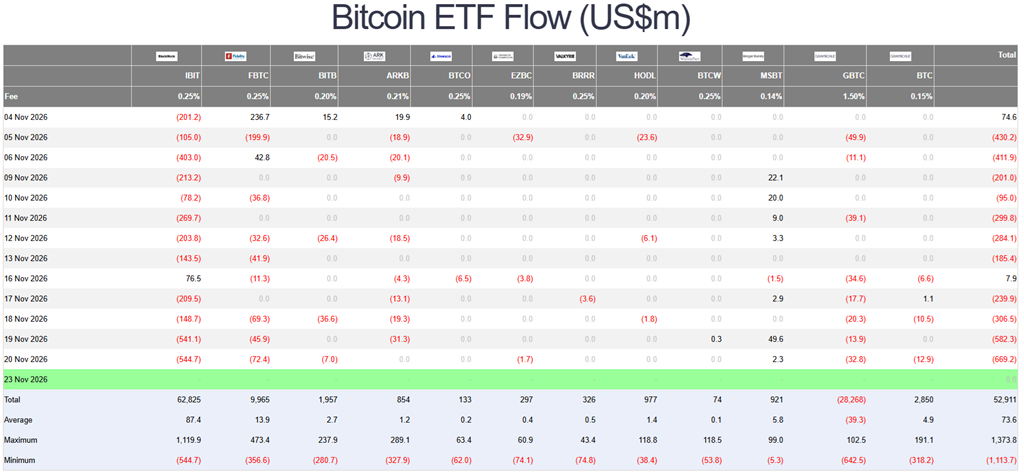
US spot Bitcoin ETFs recorded approximately $4.14 billion in net outflows during November, according to fund flow data from Farside Investors. In the week ending November 20 alone, redemptions reached roughly $1.79 billion, marking four consecutive weeks of negative flows.
BlackRock’s iShares Bitcoin Trust (IBIT) accounted for a substantial portion of these withdrawals. The fund lost approximately $1.37 billion in one week, including $541.1 million on November 19 and another $544.7 million in the following trading session.
These figures challenge the assumption that institutional participation necessarily provides price support. ETFs allow investors to gain exposure to Bitcoin through traditional financial instruments, but they also make it easier to reduce that exposure quickly when investors seek to lower their risk.
The accessibility that initially encouraged capital inflows can become a problem during market corrections. Investors do not need to leave specialized infrastructure or manage their bitcoins directly. They can sell ETF shares through the same platforms they use to trade stocks and other financial assets.
Institutional adoption does not guarantee long-term Bitcoin holders
For years, the arrival of major asset managers was presented as a transformation of the Bitcoin market. The participation of BlackRock, Fidelity, and other institutions brought financial legitimacy and opened distribution channels that had previously been inaccessible to many investors.
However, the presence of an institutional asset manager does not automatically turn everyone buying its funds into a long-term investor. ETFs can also be used by tactical traders, financial advisors, and portfolios that adjust their exposure according to economic conditions.
Moreover, aggregate fund flows do not reveal precisely who is selling. Capital leaving IBIT does not, by itself, prove that major institutional funds are abandoning Bitcoin. These withdrawals may also result from decisions made by individual clients, intermediaries, or hedging strategies.
That distinction matters, but it does not eliminate the problem. If a substantial portion of the capital flowing through ETFs reacts quickly to market corrections, institutionalization could make Bitcoin more sensitive to changes in risk appetite.

ETFs can amplify declines without causing them
Attributing Bitcoin’s decline exclusively to ETF redemptions would be an oversimplification. Price movements depend on multiple factors, including liquidity, macroeconomic conditions, and trading activity outside exchange-traded funds.
Nevertheless, persistent outflows can create substantial selling pressure when creation and redemption mechanisms require adjustments to holdings of the underlying asset. ETFs do not eliminate Bitcoin’s volatility or guarantee that their investors will buy during market downturns.
True institutional maturity requires more than passive investment products. Longer-term investment strategies, risk management tailored to BTC’s volatility, and greater regulatory clarity could encourage participation that is less dependent on immediate market movements.
It would also be unreasonable to expect ETFs to artificially support prices. Their purpose is to provide exposure to the asset, not protect it from selling pressure.
The figures from Farside Investors illustrate this contradiction: despite November’s substantial withdrawals, US Bitcoin ETFs still hold approximately $52.91 billion in cumulative net inflows since their launch. Financial adoption is real, but its scale does not guarantee stability when investors decide to reduce their positions.