
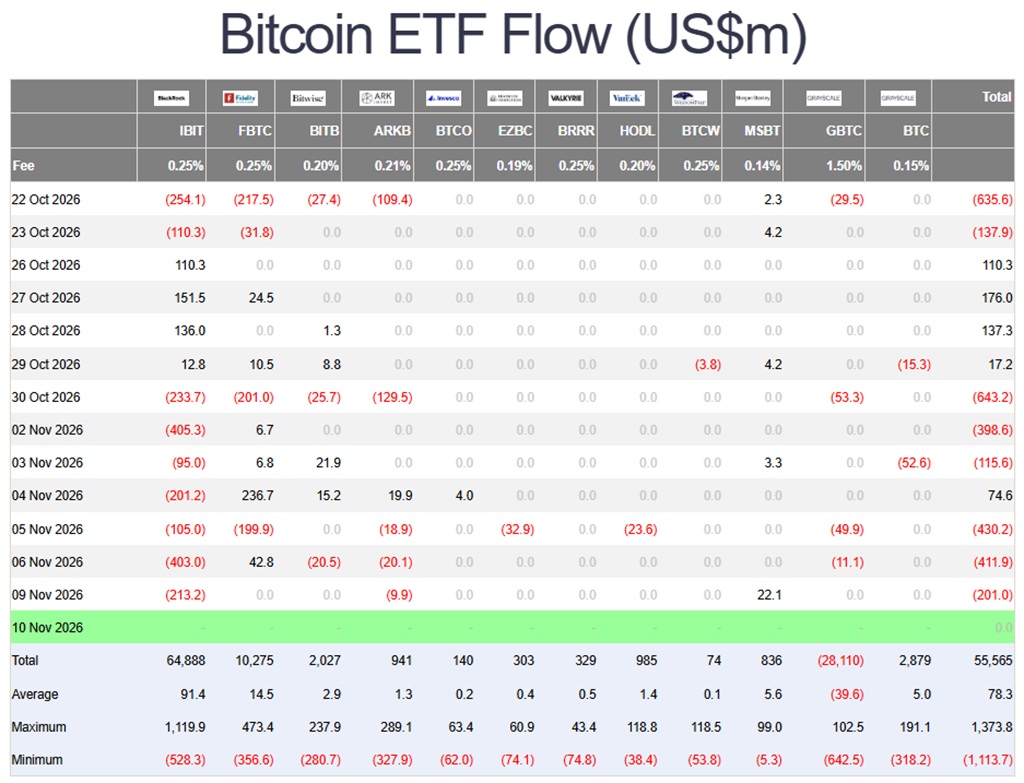
BlackRock’s Bitcoin ETF recorded $1.656 billion in outflows over seven consecutive trading sessions, challenging one of the market’s main promises since these funds were approved: that institutional capital would provide stable demand capable of cushioning downturns in the crypto market.
The iShares Bitcoin Trust (IBIT) lost $213.2 million in its latest session, according to Farside Investors’ data. Over the same seven-session period, U.S. spot Bitcoin ETFs recorded approximately $2.126 billion in net outflows.
This does not mean BlackRock has decided to abandon Bitcoin. These flows represent capital entering and leaving the fund through investor activity. But that is precisely the problem for those who viewed institutional adoption as a guarantee of stability: investors who entered through ETFs can also exit quickly.
BlackRock Shows That Institutional Capital Is Not Permanent
Since the launch of spot ETFs in the United States, much of the enthusiasm surrounding Bitcoin has rested on the prospect of attracting investment funds, financial advisors, and wealthy investors.
The expectation was that these participants would hold their positions for years and reduce the market’s dependence on speculative traders.
However, seven consecutive sessions of outflows from IBIT show that access to a regulated investment product does not eliminate investors’ sensitivity to financial conditions.
The contrast is particularly important because BlackRock manages the largest Bitcoin ETF in the U.S. market.
Nevertheless, the recent outflows must be measured against the fund’s size. IBIT has still recorded approximately $64.888 billion in net inflows since its launch. The withdrawals over seven sessions represent a fraction of that capital, although their persistence deserves attention.
The problem is not redemptions themselves. It is the expectation of stability built around the assumption that institutions would act as permanent buyers.

Market Pressure Mounts on Ethereum ETFs
Capital withdrawals are not limited to Bitcoin. U.S. Ethereum ETFs recorded $184.6 million in net outflows during the latest session. Of that amount, $119.3 million came from BlackRock’s ETHA fund.
Over seven sessions, Ethereum investment products accumulated approximately $705.5 million in net outflows.
These figures coincide with a period of uncertainty surrounding U.S. inflation and upcoming monetary policy decisions. However, they do not establish that these factors directly caused the redemptions.
What they do challenge is the idea that institutional access automatically makes cryptocurrencies less exposed to changes in risk appetite.
An ETF makes it easier to buy Bitcoin or Ethereum, but it also makes selling them easier. The same infrastructure that accelerates capital inflows can also facilitate outflows.

ETFs Have Not Eliminated Bitcoin’s Volatility
The approval of these products was important because it made cryptocurrencies more accessible through traditional financial instruments. However, it also brought these assets more closely into portfolios subject to rebalancing, liquidity needs, and risk management decisions.
When investors need to reduce their exposure, selling ETF shares can be as straightforward as selling stocks.
This does not make institutional funds a threat to Bitcoin. The freedom to enter and exit positions is a normal feature of any financial market.
But it does require abandoning an unrealistic expectation: that the arrival of BlackRock and other major asset managers would create virtually irreversible demand.
U.S. Bitcoin ETFs have still accumulated more than $55 billion in net inflows since their launch. That figure confirms they attracted substantial capital, but it does not guarantee that the money will remain invested.
Institutional participation can improve liquidity and strengthen the market over the long term. What it cannot do is eliminate selling decisions.
Bitcoin gained new buyers through ETFs, but it also attracted investors who can withdraw when their financial priorities change. That reality should be part of any serious assessment of its future market behavior.