
TL;DR
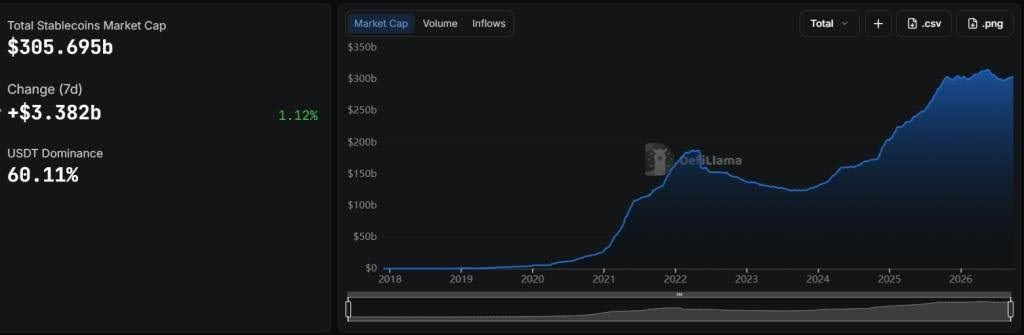
- Stablecoin supply remained near $290 billion even as Bitcoin suffered a major drawdown, while transfer activity more than doubled in a year.
- Real payment activity is growing faster than supply, with businesses accounting for most stablecoin payment volume.
- The next stage may be less about crypto liquidity and more about building always-on rails for global payments and settlement.
Stablecoins were originally designed to solve a problem inside crypto markets: providing a dollar-like asset that could move quickly between exchanges, protocols and traders without leaving the digital-asset ecosystem.
That role still exists, but the latest data suggest the market is becoming harder to explain through trading alone. Between October 2025 and August 2026, Bitcoin fell by more than 50% and the total crypto market lost more than $2 trillion, yet stablecoin supply remained around $290 billion. At the same time, transfer volume exceeded $90 trillion over the previous 12 months, more than double the level recorded a year earlier.
Stablecoins: From Liquidity to Velocity
The most interesting part of this evolution is not the size of the stablecoin market itself, but how frequently those assets are moving.
A study found that stablecoin turnover increased from 0.38 times supply in August 2024 to 0.78 times in August 2026. In other words, roughly the same pool of stablecoins is circulating significantly more frequently than it did two years ago.
That matters because liquidity held on exchanges behaves differently from money used as a payment rail. Trading collateral can remain concentrated inside a relatively closed ecosystem of crypto platforms. Payments, by contrast, require stablecoins to move between businesses, individuals, institutions, jurisdictions and different blockchain networks.
There is evidence that this transition is already underway.
Alvarez & Marsal estimates that stablecoin payments reached at least $401 billion during the first eight months of 2026, up 42% year over year, even though total supply increased by only 6%. Businesses accounted for an estimated 58% to 64% of payment volume, including between $137 billion and $153 billion in B2B settlement.
The difference between supply growth and payment growth is particularly significant. A financial system does not necessarily need an enormous stock of money if the same units can circulate efficiently between participants.
The Infrastructure Is Becoming More Important Than the Token
The expansion is also moving beyond dollar-denominated crypto markets.
Visa’s research found that transfer volume for local-currency stablecoins increased 16-fold between 2023 and early 2026, far outpacing supply growth. The data indicate increasing use for payments, settlement and treasury management rather than simply holding the assets. That development changes the way stablecoins should be viewed.
A stablecoin used to move money between two crypto exchanges is primarily a liquidity instrument. A stablecoin used to pay a supplier, settle an invoice or transfer corporate funds across borders starts looking more like financial infrastructure.
The distinction is important because infrastructure tends to be judged by different criteria. Availability, settlement speed, interoperability, compliance and the ability to operate continuously become more important than simply maintaining a stable price.
This does not mean stablecoins have already replaced traditional payment networks. In fact, raw blockchain transfer figures can be misleading. The BIS has estimated that only a small fraction of headline stablecoin transaction volume represents actual payment activity, with much of the remainder consisting of trading, internal transfers and other blockchain operations.
But that caveat does not erase the broader trend. It makes the more relevant question clearer.
The important development is not whether every dollar of reported stablecoin volume represents a real-world payment. It is whether enough genuine payment activity is emerging to justify building permanent infrastructure around it.
The Next Stablecoin Market May Look Less Like Crypto
The strongest signal may ultimately be the behavior of the companies building around these assets.
Businesses are beginning to use stablecoins for supplier payments, payroll, remittances and treasury operations, while financial institutions and payment networks are exploring them as another settlement mechanism. That creates a different growth model from the one that dominated the previous crypto cycles.
If stablecoin adoption depends primarily on traders, its expansion will remain closely connected to market activity. If businesses begin relying on stablecoins to move money between countries and counterparties, demand can continue even when crypto prices are falling.
The resilience of supply during a major market downturn is therefore more than a statistic about investor behavior. It suggests that at least part of the stablecoin economy is becoming independent from the speculative cycle that created it.
The irony is that the biggest transformation may happen without stablecoins becoming more visible to consumers.
A company may pay an overseas supplier in a stablecoin without its customer ever knowing. A treasury department may move funds across jurisdictions outside traditional banking hours. A payment processor may use a stablecoin in the background while the recipient ultimately receives fiat currency.
If that model expands, stablecoins will no longer be defined primarily by their role inside crypto markets.
They will become part of the financial plumbing itself: a digital layer for moving dollars and other currencies around the world, continuously and programmatically, even when the people using it never see the blockchain behind the transaction.