
Crypto’s ability to create new digital assets has reached a point where the industry faces a question that goes beyond another debate over altcoin valuations. The issue is whether the market can provide enough capital, liquidity, users and attention to support the rapidly expanding number of tokens competing for economic activity.
CoinMarketCap reported that more than 600,000 new tokens launched in January 2025 alone, a 12-fold increase from the same period a year earlier. The surge reflected the growing availability of token-launch platforms that have made creating new assets easier and faster. However, easier issuance does not automatically create demand.
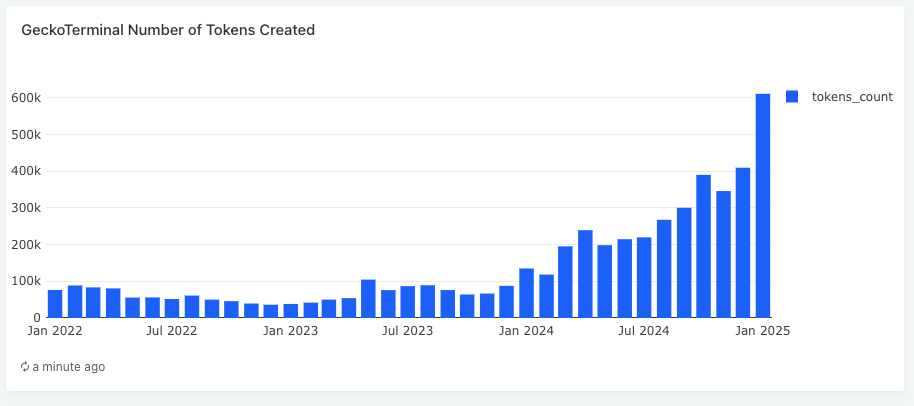
GeckoTerminal number of tokens created. Source:Bobby Ong
As the number of tokens grows, the market must divide a finite pool of capital, liquidity and investor attention among an expanding number of assets.The increase in token creation does not prove that crypto has produced more assets than the market can support.
Nevertheless, it raises a structural question about whether token supply is growing faster than the resources needed to maintain active and economically meaningful markets. That distinction matters because a token can exist without developing enough demand to support sustained trading activity.
Token Supply Grows Faster Than Market Demand
Creating a token does not create new capital. Instead, investors often move existing funds from one asset to another when they enter a new market. Consequently, a new token can attract money without increasing the overall amount of capital available across crypto.
This competition becomes more important when liquidity enters the equation. A functioning market needs enough buyers and sellers to absorb transactions without causing sharp price movements. New tokens often begin with limited trading activity, which can make their markets more vulnerable to volatility and manipulation.
Research examining token proliferation on Uniswap V2 found that newly created tokens can face low liquidity and inefficient price discovery. The researchers also identified risks including honeypots, rug pulls and sandwich attacks, particularly in markets with limited liquidity.
Moreover, liquidity tends to concentrate around assets that already have stronger trading activity and demand. Market makers have greater incentives to provide liquidity where transaction volumes can generate sustainable returns. As a result, the growth of the token universe does not guarantee an equal expansion in liquidity across those assets.
Liquidity Becomes Harder to Spread Across Assets
The pressure on liquidity becomes even clearer when considering the number of blockchain networks supporting crypto assets.Crypto now operates across numerous layer-1 networks and an expanding collection of layer-2 systems. Each network can develop its own applications, tokens and liquidity pools. Although this expansion increases the number of places where blockchain activity can occur, it can also divide liquidity and users between separate ecosystems.
The Bank for International Settlements said in July 2026 that the growth of layer-1 and layer-2 networks has fragmented infrastructure, liquidity and assets across and within blockchains. The BIS also noted that bridges and other interoperability tools can reduce these barriers while introducing additional dependencies.
The same problem can affect assets that operate across several networks. The BIS noted that the same stablecoin issued on different blockchains can effectively function as separate assets because the underlying ledgers do not communicate natively.
New Tokens Face a Growing Battle for Investor Attention
Capital can move between assets, but investor attention is harder to expand. Investors have limited time to research projects, monitor markets and assess whether new assets have genuine economic activity.
At the same time, traders face an expanding stream of token launches, listings and market narratives. As the number of assets increases, each project must compete for visibility alongside thousands of alternatives.
“Investor attention has become an increasingly important factor in crypto markets, with research and market observations linking sharp changes in attention to changes in trading activity and asset volatility.”
— Trendle (@TrendleFi) September 7, 2025
Notably, the cost of launching a token can now be extremely low, while building sustained demand remains difficult. A token can enter the market within minutes, but establishing recurring users, deep liquidity and useful applications can take years.
Crypto Liquidity Concentrates in Stronger Assets
Crypto does not necessarily need fewer tokens. New assets can represent useful applications, networks or financial products. However, the market cannot distribute unlimited capital, liquidity and attention equally across every asset.
If token creation continues to outpace the growth of capital, users and investor attention, market activity may become increasingly concentrated. Assets with deeper liquidity, stronger usage and established demand can attract a larger share of available resources, while weaker markets struggle to maintain participation.
Crypto has made the process of creating an asset increasingly cheap. Building lasting demand around that asset remains considerably harder. As token issuance continues to expand, that gap will determine which projects develop durable markets and which lose liquidity and attention to stronger competitors.